 AI-generated analysis published under the editorial responsibility of Rohit Sinnas. How it works →
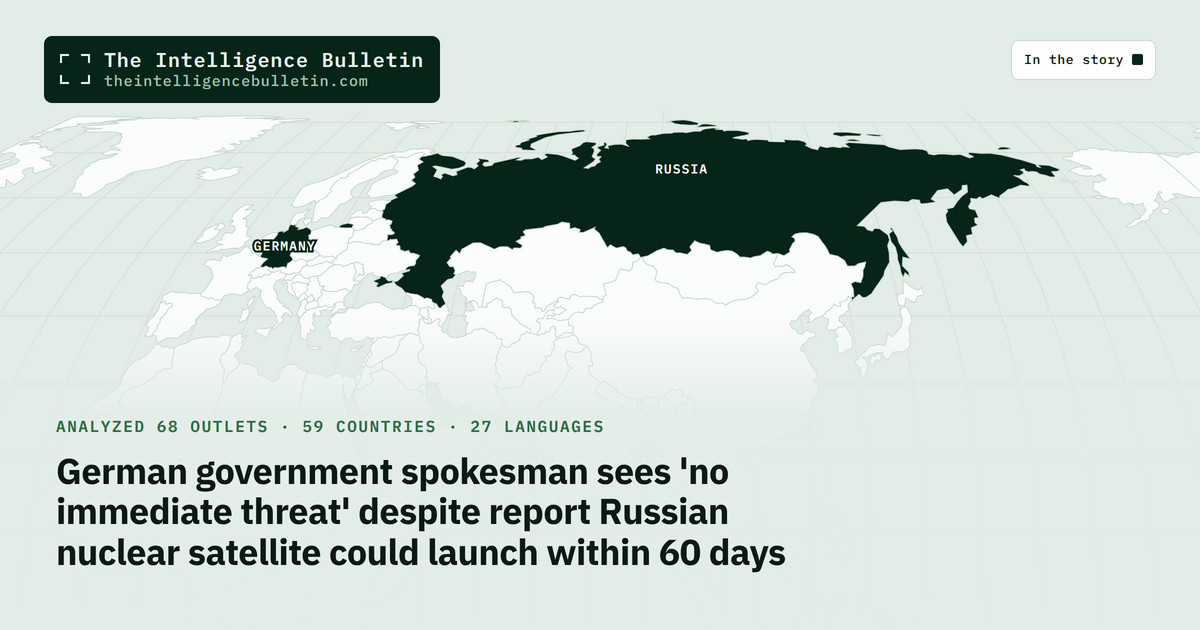
See the 59 countries
Albania, Argentina, Australia, Austria, Azerbaijan, Belarus, Benin, Brazil, Bulgaria, Burundi, Chile, China, Croatia, Cyprus, Czech Republic, Denmark, Egypt, Estonia, Finland, France, Germany, Ghana, Greece, Hungary, India, Israel, Italy, Jordan, Kyrgyzstan, Latvia, Lithuania, Luxembourg, Madagascar, Moldova, New Zealand, Nigeria, Norway, Pakistan, Paraguay, Poland, Portugal, Qatar, Romania, Russia, Senegal, Serbia, Slovakia, South Africa, Spain, Sweden, Taiwan, Thailand, Turkey, Tuvalu, Ukraine, United Arab Emirates, United Kingdom, United States, Uzbekistan
A German investigation citing unnamed officials says Western intelligence believes Russia could launch a nuclear-capable satellite, Sputnik-S, by December; Russia’s embassy and the Kremlin dismiss it, and Germany’s government spokesman says there is no immediate threat. An orbital warhead would breach the 1967 treaty.
Across the press: Only Austria’s Kurier carried Germany’s government spokesman saying there is no immediate threat; Fox News ran the story as a 60-day countdown.
Source base: 5 outlets read in full (United States, Ukraine, Austria, Egypt, Benin), selected from 68 analyzed.
- Denied on the recordWestern intelligence services, with Germany’s BND and Bundeswehr sharing information, believe Russia has built a satellite called Sputnik-S designed to carry a nuclear warhead and has stored it near Moscow for several years.Source: Joint investigation by WDR, NDR and Süddeutsche Zeitung citing unnamed security officials, relayed by Reuters and Tagesschau; Russia’s embassy in Berlin called it baseless and part of a propaganda campaign, and Kremlin spokesman Dmitry Peskov said the report was hardly worth taking seriously.
- 3 of 5 · one shared reportA warning shared among several NATO countries in early November said the satellite could launch within about 60 days, and the Bundeswehr’s Space Command judged a December launch possible.WDR, NDR and Süddeutsche Zeitung investigation, relayed by Reuters and Tagesschau; all chains trace to that one report.
- 3 of 5 · one shared reportBundeswehr experts briefed senior government figures, including Defense Minister Boris Pistorius, on the threat.WDR, NDR and Süddeutsche Zeitung investigation, as relayed.
- 2 of 5 · one shared reportChancellor Friedrich Merz, speaking alongside NATO Secretary General Mark Rutte in Berlin on November 23, called the reports not new but ‘shocking’ and said they show what escalation Russia is apparently prepared for.Merz on the record, as reported by Reuters.
- 1 of 5 · Kurier onlyGerman government spokesman Stefan Kornelius said on November 23 that there is no immediate threat at the moment, while a Bundeswehr spokesman declined comment but said Russia has the relevant capability.Kornelius and an unnamed Bundeswehr spokesman, on the record, as carried in Kurier’s ticker.
Full analysis
What happened Why it matters How each country tells it Where accounts conflict Room for disagreement Our assessment Sources and evidence
What happened
On Monday, November 23, the German public broadcasters WDR and NDR and the newspaper Süddeutsche Zeitung published a joint investigation. It reported that Western intelligence services believe Russia has built a satellite called Sputnik-S, designed to carry a nuclear warhead, and has kept it in the Moscow region for several years. Germany’s foreign intelligence service, the BND, and the Bundeswehr are reported to have shared information about it with allies. La Nouvelle Tribune, relaying the story through Tagesschau, notes that the account rests on security officials who were not named.
The investigation also put a timeline on the claim. A warning circulated among several NATO countries in early November said the satellite could launch within about 60 days. The Bundeswehr’s Space Command judged a December launch possible, which La Nouvelle Tribune renders as possible from the start of December. El Watan’s Reuters-based account adds that the satellite would be ready for use shortly after reaching orbit. German military experts are reported to have briefed senior government figures, including Defense Minister Boris Pistorius.
Berlin answered with more than one voice on the same day. Chancellor Friedrich Merz spoke alongside NATO Secretary General Mark Rutte, and the Reuters account relayed by UNIAN quotes him saying the reports that Russia plans to station nuclear arms in space "are not new, but no less shocking for that," and that they show "what escalation Russia is apparently prepared for." He said this in the middle of demanding that Moscow end its "dangerous provocations" over Polish airspace. According to Kurier, Polish prosecutors identified three objects that crashed in Poland the previous Friday as Russian Kh-101 cruise missiles. Rutte, as quoted by Fox News citing Reuters, said NATO would "defend every inch of NATO territory." He added that alliance planning covers threats in space and that NATO has response options not always visible to the public.
At the government press briefing, the message was cooler. Kurier reports that a government spokesman said Berlin takes the reports "sehr ernst," very seriously. Stefan Kornelius, the government spokesman, added: "Eine unmittelbare Bedrohung ist momentan nicht gegeben" (an immediate threat is not present at the moment).
The military gave a mixed answer. A Bundeswehr spokesman declined to comment on the report but said Russia has the relevant capability. He described a nuclear blast in space as meaning "Zurück in die Steinzeit," back to the Stone Age. According to La Nouvelle Tribune, the defense ministry refused to discuss Russian intentions, citing confidentiality.
Moscow rejected the account. Russia’s embassy in Berlin said it had no information on the matter, rejected "all unfounded insinuations" about Russia’s space activities as "part of a propaganda campaign," and said those activities are peaceful and consistent with its international obligations. Kremlin spokesman Dmitry Peskov, quoted by Fox News via The Moscow Times, said: "We haven’t seen the report. But there are so many ‘alleged’ and ‘possible’ claims in it, attributed to who knows whom, that it’s certainly hardly worth taking them seriously."
The concern has a history. In February 2024 the Biden administration said Russia was developing a troubling anti-satellite capability that had not been deployed, and El Watan recalls that Russia denied it. La Nouvelle Tribune adds that Washington then told European allies a launch could come within the year, that US analysts held that judgment with low confidence, and that no launch followed. Washington has since tied the program to Cosmos 2553, launched in November 2021, which Moscow describes as a research craft.
In October 2026, the US Defense Intelligence Agency’s Challenges to Security in Space report stated plainly: "Russia is developing a satellite designed to carry a nuclear weapon." The German report surfaced four days after Donald Trump, Vladimir Putin and Xi Jinping met in Shenzhen. Fox News reports the three leaders declared that nuclear war should never be fought but made no binding arms-control commitments.
Why it matters
The 1967 Outer Space Treaty bars placing nuclear weapons in orbit, so a launch would break one of the oldest arms-control rules still standing. That would come just as the three largest nuclear powers had signed a statement against nuclear war without any binding commitments behind it.
The practical stakes fall on everyone below. A nuclear burst in low orbit does not hit a single target. El Watan’s account describes radiation and electromagnetic-pulse effects that can disable many satellites at once, plus debris that can strike others. Fox News, drawing on the October DIA report, describes the possible loss of thousands of government and commercial satellites that carry navigation, communications, financial transactions and weather data.
The only precedent is American. La Nouvelle Tribune notes that a 1.45-megaton US test over the Pacific in July 1962 damaged several satellites in low orbit. The low-orbit fleet is now far larger, and it includes the Starlink network that Ukraine’s military depends on. Michael Traut, the former head of Germany’s space command, is quoted by La Nouvelle Tribune as saying such a detonation would be "more or less the end" of using that global commons.
How each country tells it
- Fox News · United States · carries WDR, NDR and Süddeutsche ZeitungTurns the German joint investigation into a Western-intelligence countdown, with a launch possible in under 60 days, and builds out the American backstory: the Defense Intelligence Agency’s October assessment and the Biden administration’s February 2024 disclosure.
- UNIAN · Ukraine · carries ReutersMakes the story Merz’s demand that Russia stop ‘dangerous provocations’ over its missiles in Polish airspace, with the nuclear-satellite reports appearing as one remark he called ‘shocking.’
- Kurier · Austria · carries WDR, NDR and Süddeutsche ZeitungRuns the satellite report as three short entries in a live war ticker dominated by the Libya corvette strike, the Polish airspace breach and attacks on Kyiv.
- El Watan News · Egypt · carries ReutersUnder a ‘bomb in space’ breaking-news headline, it relays Reuters’ summary of the German investigation, including the Sputnik-S name, the 60-day warning and the German Space Command’s December estimate.
- La Nouvelle Tribune · Benin · carries TagesschauRelays the investigation via Tagesschau as NATO’s fear of a December launch, and flags that it rests on unnamed security officials and that Germany’s defense ministry refused comment on confidentiality grounds.
Where accounts conflict
The first dispute is whether the weapon exists at all. The investigation, citing unnamed officials, says Sputnik-S exists, is built to carry a warhead and has been stored near Moscow. Russia’s embassy calls this baseless propaganda. Peskov’s dismissal attacks the anonymous sourcing rather than the specifics, and he said he had not read the report.
The second dispute is how close the danger is, and it sits inside the Western side. The early-November warning described in the investigation put a launch within roughly 60 days, and Fox News made that its headline. Germany’s own government spokesman said on the record that no immediate threat exists at the moment.
Room for disagreement
The strongest case against discounting the timeline is that capability is not in doubt on the Western side. The DIA’s public October report is a separate chain of evidence from the German investigation. A Bundeswehr spokesman affirmed the capability on the record, and Merz called the reports not new. A Space Command estimate naming a month is more specific than the hedged US warning of 2024.
Kornelius’s "at the moment" also leaves room for a launch weeks away. A satellite designed to carry a warhead could go up without anyone outside Russia being able to confirm what it holds, which Fox News lists as an open question.
Our assessment
It is unlikely that Russia places a nuclear-armed satellite in orbit before the 60-day window flagged in early November closes, around early January. Every outlet here traces to one investigation built on anonymous officials. The DIA report corroborates the program but not the timing.
The only on-record German government statement on urgency points away from imminence. The one comparable warning, in 2024, was held with low confidence and proved wrong. Each party has an interest in how readers see this: Moscow in dismissing it, and a Berlin government pressing Russia over Polish airspace in keeping the alarm audible.
The source set includes no German original, no Russian outlet and no US government comment. Fox News was still awaiting replies from the White House, Pentagon and US Space Command.
What would change this: a Russian launch that US or German officials publicly identify as Sputnik-S, or on-record US confirmation of the December timeline.
What would change this: a Russian launch that US or German officials publicly identify as Sputnik-S, or on-record US confirmation of the December timeline.
Sources and evidence
Press quoted
- Does Western intelligence know whether Sputnik-S already carries a nuclear warhead, and does it hold this assessment with more confidence than the February 2024 US warning that, per La Nouvelle Tribune, predicted a launch within the year that never came?
- When Berlin’s spokesman said there is no immediate threat at the moment, was he disputing the 60-day launch window or only saying that a launch itself would not yet mean a detonation?
- What does Washington say? Fox News records unanswered requests to the White House, Pentagon and US Space Command, and no source quotes a US official on the new assessment.
That’s how the world told the story.
Get our daily open-source intelligence on world events in your inbox — one email a day, up to six stories.
Subscribe freeNo spam. One-click unsubscribe. See the latest email →