 AI-generated analysis published under the editorial responsibility of Rohit Sinnas. How it works →
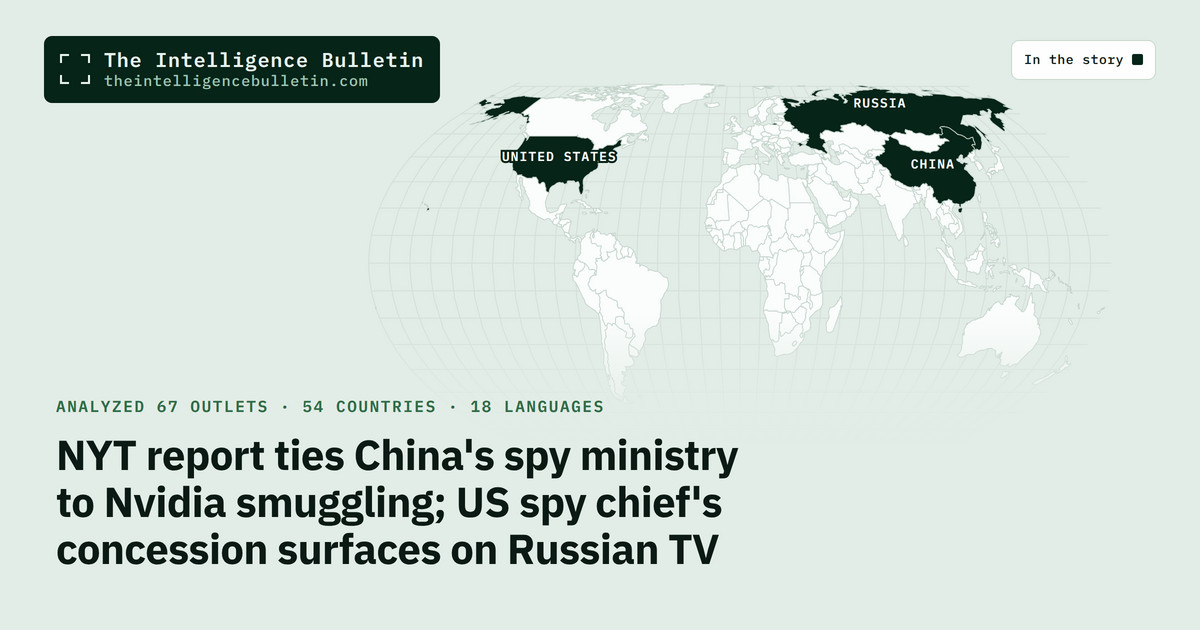
See the 54 countries
Albania, Argentina, Australia, Austria, Azerbaijan, Bangladesh, Brazil, Bulgaria, Burundi, Canada, China, Colombia, Egypt, Fiji, Finland, France, Germany, Greece, Guyana, Haiti, Hong Kong, India, Indonesia, Iraq, Ireland, Israel, Italy, Japan, Jordan, Madagascar, Mexico, New Zealand, Nigeria, Oman, Pakistan, Philippines, Poland, Qatar, Romania, Russia, Saudi Arabia, Serbia, Singapore, South Korea, Spain, Sri Lanka, Switzerland, Syria, Taiwan, Thailand, United Arab Emirates, United Kingdom, United States, Vietnam
Jensen Huang has quit Nvidia, and US authorities are investigating Alice Huang and her firm. The New York Times, citing people familiar with US intelligence reports, says China’s Ministry of State Security ran chip smuggling. President Trump has questioned whether she spied.
Across the press: Only Russian state outlet Vesti carries Clayton’s concession that China found channels to Nvidia chips, and it leaves out the Times’s spy-ministry account.
Source base: 5 outlets quoted (United States, Taiwan, Russia, Germany, Jordan), selected from 67 analyzed. 3 read in full, 2 by their headlines only.
- 1 of 5 · Bild onlyAlice Huang was in contact with a Ministry of State Security official from spring 2025 to fall 2026, and her partner Kang Wei worked with the same service.The New York Times, citing several people with knowledge of US intelligence reports, as relayed by Bild; no named official confirms it.
- 2 of 5 · one shared reportMegaspeed, where Alice Huang worked until 2025, bought large quantities of advanced Nvidia chips, some of which allegedly were smuggled to China, and China’s security ministry ran the smuggling effort for at least two years.The New York Times, relayed by Bild in its text and by Liberty Times in its headline.
- 1 of 5 · Vesti.ru onlyClayton allowed that China found channels to obtain top Nvidia chips.Vesti.ru, quoting Clayton’s CNN interview; in the ABC interview read here, he did not say this when asked about Chinese military use.
- 2 of 5 · reported separatelyUS authorities, including the Justice Department, are investigating Alice Huang and her firm.DNI Jay Clayton on the record, in ABC’s ‘This Week’ interview and, per Vesti, in a CNN interview; Vesti adds that Nvidia’s board is also investigating.
- 2 of 5 · reported separatelyJensen Huang resigned as Nvidia CEO and left its board in early November after reports of an affair with Alice Huang, who is suspected of ties to Chinese intelligence.Vesti.ru; Bild, relaying the New York Times, refers to him as ex-Nvidia boss.
Full analysis
What happened Why it matters How each country tells it Where accounts conflict Room for disagreement Our assessment Sources and evidence
What happened
China’s Ministry of State Security was in contact with the woman at the center of the Nvidia scandal and, according to The New York Times, ran an effort to smuggle the company’s most advanced chips into China for at least two years. That account appears in this set secondhand. Germany’s Bild relays the Times report in detail. Taiwan’s Liberty Times, whose article could be read only by its headline, states flatly that the security ministry stood behind Nvidia chip smuggling and credits the Times with exposing a secret operation at least two years old.
The report lands on a scandal already weeks old. In early November, Jensen Huang, 63, Nvidia’s chief executive, resigned and left the company’s board after reports of an affair with Alice Huang, 42, a businesswoman suspected of ties to Chinese intelligence. Bild notes the two are not related. Vesti, the news site of Russian state television, reports that both Nvidia’s board and the Justice Department opened investigations.
In Bild’s relay, the Times cites several people with knowledge of US intelligence reports on Alice Huang. They say she was in contact with a ministry official from spring 2025 to fall 2026, a span that at least partly overlaps the affair. They also say US agencies gathered evidence that her business partner Kang Wei, often introduced as her husband, worked with the same service. The contacts coincide with the period in which Megaspeed bought large quantities of advanced Nvidia chips; she worked there until 2025. Some of those chips went to data centers in Southeast Asia, and some were allegedly smuggled into China. Under a headline reading "Bewiesen!" ("Proven!"), Bild’s own text concedes that the extent and exact timing of the contacts remain unclear. A spokesman for Jensen Huang declined to comment to the Times. The White House, the State Department, the Chinese embassy in Washington, Alice Huang and Kang Wei did not respond.
A second reporting chain points to the scale of the trade. Jordan’s Jo24 headlines a Financial Times investigation into a smuggling network for Nvidia chips worth billions, "not just a love affair." Whether the FT names Megaspeed or the ministry could not be determined from the headline.
The only official on the record is Director of National Intelligence Jay Clayton. On ABC’s "This Week" on November 22, Jonathan Karl asked whether Alice Huang had passed information to or otherwise helped the Chinese government. Clayton replied that, as Attorney General Blanche has made clear, "there is an investigation ongoing into her firm and into her," and said he would await its outcome. Karl then asked whether he could say with confidence that Nvidia chips had not supported the Chinese military. Clayton called them "the jewel" that "everybody wants," said people "will break the law," and pointed to indictments "involving other companies." He said he did not know where Alice Huang is; Karl noted reports that she is in China.
Vesti quotes Clayton going further in a CNN interview. He called top Nvidia chips a kind of "currency" that every country tries to obtain, "and I allow that there are channels by which China managed to get them," while urging that facts be gathered before judgment. In this set, that concession appears only through Russian state media. Vesti’s text never mentions the Times’s ministry account or Megaspeed.
Why it matters
The United States has restricted high-end chip sales to China since September 2022, Vesti notes. On ABC, Clayton described the policy as "restrictions," "not bans." The aim, he said, is to keep "exquisite" technology from adversaries while letting less advanced chips flow into the global infrastructure buildout, with Commerce and Treasury "metering" access. If the Times’s sources are right, the opponent of that regime was a foreign intelligence service, not only gray-market traders chasing a margin. The chips moved through a firm buying at volume. That changes what enforcement has to defeat.
The report also lands in a divided Washington. On the same broadcast, Karl read Senator Tom Cotton’s charge to The Wall Street Journal that Commerce Secretary Howard Lutnick ignored repeated warnings about Chinese front companies smuggling AI chips, and Cotton’s call to "catalogue the damage." Clayton would say only that "there is a debate to be had." President Trump, per Bild, has played down the affair and said he would not oppose Jensen Huang’s return to Nvidia. The report arrives days after what ABC called an imperial welcome for Trump in China, his third meeting with Xi Jinping this year, and as Democrats prepare to take over Congress.
Beijing’s side is missing from this account. The set holds no Chinese outlet, and the embassy did not answer the Times.
How each country tells it
- abcnews.com · United States · original reportingIn its own November 22 ‘This Week’ interview, Jonathan Karl asks Director of National Intelligence Jay Clayton whether Alice Huang, ‘the woman who reportedly had an affair with Jensen Huang,’ helped the Chinese government. Clayton answers only that, as Attorney General Blanche has said, ‘there is an investigation ongoing into her firm and into her,’ and says he does not know where she is.
- Liberty Times (自由時報) · Taiwan · carries The New York TimesOnly the headline could be read. It states flatly that China’s Ministry of State Security is behind Nvidia chip smuggling and credits the New York Times with exposing an operation at least two years old.
- Vesti.ru · Russia · carries CNNIt reports that Clayton told CNN China ‘could have obtained access’ to advanced Nvidia chips, quoting him: ‘I allow that there are channels by which China managed to get them.’ It adds Dmitry Kiselyov’s view that Jensen Huang’s adultery was only a pretext, and that the real aim was a US move to cut off Nvidia chip exports to China.
- Bild · Germany · carries The New York TimesIts headline says ‘Proven!’ The story relays the New York Times: Alice Huang, 42, was in contact with a Ministry of State Security official from spring 2025 to fall 2026, overlapping with her affair with Jensen Huang, 63. Her business partner Kang Wei worked with the same service. Megaspeed, where she worked until 2025, bought large quantities of Nvidia chips, some of them allegedly smuggled to China.
- Jo24 · Jordan · carries Financial TimesOnly the headline could be read. It says the Financial Times has uncovered a smuggling network for Nvidia chips worth billions, ‘not just a love affair.’
Where accounts conflict
Whether Alice Huang worked for Chinese intelligence is disputed. Trump, Bild reports, has questioned whether she spied at all. The Times’s anonymous sources, drawing on US intelligence reports, describe more than a year of contact with a ministry official. Bild reads that as proof, though contact with an official is not the same as tasking, and no named official has confirmed it.
What the scandal is about is also contested. The Times account makes it a Chinese state operation to get chips past US controls. On Vesti, presenter Dmitry Kiselyov argues the adultery was only a formal pretext for removing Jensen Huang, and that Washington’s real aim was to choke off Nvidia’s AI chip exports to China.
Room for disagreement
The strongest case against holding the ministry claim at arm’s length comes from Clayton himself. If Vesti’s quotation is accurate, the director of national intelligence has already allowed on CNN that China found channels to the chips. Cotton is pressing for an accounting, and he concedes the administration "took some steps this week on this issue." A Democratic Congress would have both the motive and the subpoena power to drag the intelligence reports into the open. And if Kiselyov’s reading holds any truth, Washington is tightening exports, so officials would have reason to publicize a ministry link rather than sit on it.
Our assessment
It is likely that no US official confirms on the record that China’s Ministry of State Security ran Nvidia chip smuggling before the Justice Department investigation produces charges or findings. The settled spine is narrow: Jensen Huang is out, and the investigation into Alice Huang and her firm is confirmed on the record. The ministry account rests on a single reporting chain of anonymous people describing intelligence reports, carried here only through Bild and a Liberty Times headline. Asked directly on ABC, Clayton deferred to the investigation each time. The administration has interests in a softer reading: a fresh summit with Xi, a chip policy built on metered access, and a president who doubts Alice Huang spied. Cotton gains from the harder reading, as does a tabloid selling "Proven!" Kiselyov’s pretext theory suits a Kremlin unwilling to cast its main partner as a spy state. Even unconfirmed, the report moves the debate from whether chips leak to who is taking them.
What would change this: an indictment or Justice Department filing that names the Ministry of State Security, or Clayton or Attorney General Blanche saying so publicly.
Sources and evidence
Press quoted
- Did Alice Huang pass Nvidia information or chips to the Ministry of State Security, or do the intelligence reports the New York Times describes establish only contact, given that Bild says the extent and timing remain unclear?
- Does the Financial Times’ billion-dollar smuggling network involve Megaspeed and Chinese state security, or is it a separate commercial operation?
- Is Alice Huang in China, as Jonathan Karl said reports suggest, and has Beijing answered the allegation, given that the Chinese embassy did not respond to the Times and the selected sources include no mainland Chinese outlet?
That’s how the world told the story.
Get our daily open-source intelligence on world events in your inbox — one email a day, up to six stories.
Subscribe freeNo spam. One-click unsubscribe. See the latest email →