 AI-generated analysis published under the editorial responsibility of Rohit Sinnas. How it works →
See the 55 countries
Afghanistan, Argentina, Australia, Azerbaijan, Bangladesh, Barbados, Bolivia, Brazil, Canada, Chile, China, Dominican Republic, France, Gambia, Germany, Greece, Grenada, Hungary, India, Indonesia, Ireland, Israel, Jamaica, Japan, Jordan, Kenya, Kosovo, Kyrgyzstan, Luxembourg, Malaysia, Malta, Mexico, New Zealand, Nigeria, Pakistan, Panama, Portugal, Qatar, Romania, Russia, Saudi Arabia, Slovakia, Somalia, South Korea, Sri Lanka, Suriname, Sweden, Switzerland, Taiwan, Thailand, Turkey, Uganda, Ukraine, United Kingdom, United States
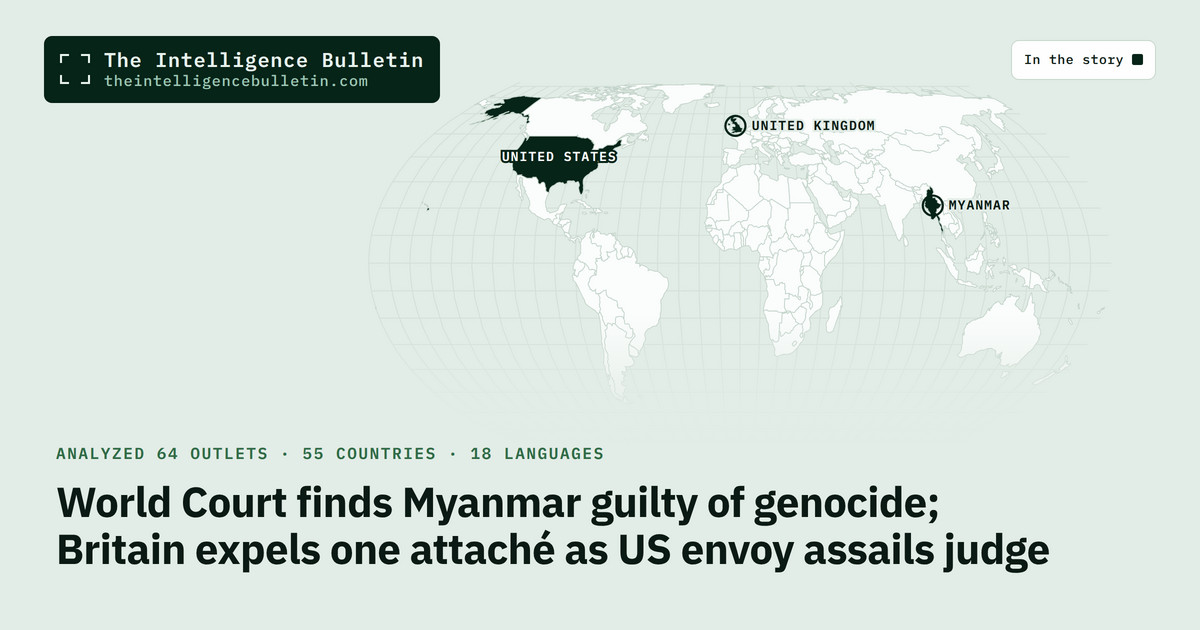
The UN’s top court ruled November 19 that Myanmar committed genocide against the Rohingya, its first such finding against any state. Myanmar, which called the case unfounded, faces a return order the court cannot enforce; Britain has expelled its military attaché.
Across the press: In the reporting read, Myanmar’s only penalty is Britain expelling one attaché, while The Guardian reports fears Washington will sanction the ICJ judges instead.
Source base: 5 outlets quoted (Bangladesh, United Kingdom, France, Malaysia, Thailand), selected from 64 analyzed. 3 read in full, 2 by their headlines only.
- 4 of 5 · reported separatelyOn Thursday, November 19, 2026, the International Court of Justice ruled that Myanmar committed genocide against the Rohingya in northern Rakhine State, the first time the court has found a state responsible for committing the crime.The Daily Star via AFP and Reuters, quoting ICJ President Yuji Iwasawa; The Guardian editorial; Free Malaysia Today via AFP; Prachatai via the UK Foreign Secretary’s statement
- 2 of 5 · reported separatelyThe court held that an intention to destroy a substantial part of the Rohingya was the ‘only reasonable inference’ from Myanmar’s conduct.The Daily Star via AFP, quoting Iwasawa; The Guardian editorial, which adds that the judgment was by majority and applied rather than changed the legal standard
- 2 of 5 · reported separatelyThe court found that Myanmar’s security forces killed thousands of Rohingya, with an estimate of about 10,000 dead supported by the evidence.The Daily Star via Reuters and AFP, quoting the court; The Guardian editorial
- 2 of 5 · reported separatelyMyanmar must facilitate the safe and dignified return of displaced Rohingya and the reunification of families, and according to The Guardian it has two years to set out restitution plans before the court takes the issue up again.The Daily Star via Reuters, quoting Iwasawa; the two-year deadline appears only in The Guardian editorial
- 2 of 5 · reported separatelyBritain expelled Myanmar’s military attaché after the ruling, and its Foreign Secretary asked for an urgent UN Security Council meeting.Prachatai, citing the Gov.UK statement by Foreign Secretary Ed Miliband; The Guardian editorial reports the expulsion but not the Security Council request
- By November 2028Myanmar’s two-year deadline to set out restitution plans, after which the court takes the issue up again, according to The Guardian.
Full analysis
What happened Why it matters How each country tells it Room for disagreement Our assessment Sources and evidence
What happened
On Thursday, November 19, 2026, the International Court of Justice ruled that Myanmar committed genocide against the Rohingya in northern Rakhine State. It is the first time the UN’s highest court has found a state responsible for committing the crime itself. "The Republic of the Union of Myanmar has committed genocide against the Rohingya group in northern Rakhine State, in violation of its obligations under the Convention on the Prevention and Punishment of the Crime of Genocide," ICJ President Yuji Iwasawa said at the Peace Palace in The Hague, opening a reading that AFP said was expected to run around three hours.
The finding turned on intent, the hardest element of genocide to prove. "On the basis of all the evidence taken together, the Court is of the view that the only reasonable inference that can explain Myanmar’s actions is an intention to destroy a substantial part of… the Rohingya population in northern Rakhine State," Iwasawa said, as quoted by AFP. The court found that Myanmar’s security forces "killed thousands of Rohingya civilians, perpetrated widespread acts of sexual violence as well as acts of extreme violence against children and attacked fleeing Rohingya" as they ran for Bangladesh. AFP and Reuters reported that the court judged an estimate of about 10,000 dead over the whole 2017 "clearance" campaign to be supported by the evidence. A narrower count in the Reuters timeline fits inside that one: a Médecins Sans Frontières survey found at least 6,700 dead, including at least 730 children under five, in the single month from August 25 to September 24, 2017. The Guardian’s editorial adds a detail the wire copy did not carry: the judgment was by majority, not unanimous.
On remedies, Myanmar must "facilitate the safe and dignified return to their place of residence and the reunification of families for the Rohingya displaced as a result of Myanmar’s wrongful acts," Iwasawa said, according to Reuters. The Guardian reports that Myanmar has two years to set out plans for full restitution. If it fails, the court takes the issue up again.
The Gambia filed the case on November 11, 2019, under the 1948 Genocide Convention. In Gambia’s argument, as reported by Reuters, the military offensive drove at least 730,000 Rohingya out of Myanmar. Aung San Suu Kyi defended Myanmar in person in December 2019. The court ordered protective measures in January 2020. The military seized power in February 2021, and the court affirmed its jurisdiction in July 2022. When merits hearings opened in January 2026, Myanmar’s foreign ministry called the allegations "flawed and unfounded in fact and law." None of the reporting read carries a Myanmar response to the verdict itself.
In the Cox’s Bazar camps, hundreds watched on a giant screen and many wept, AFP reported in a dispatch carried by Free Malaysia Today. Sayed Ullah, a former president of the United Council of Rohingya, thanked Bangladesh, The Gambia and the Organisation of Islamic Cooperation and asked everyone "to be with us till we return home." He also said the court had recognized the Rohingya as "a distinct group," which matters because Myanmar refuses to list them as an official ethnic group. Mohammed Osman, 20, whose parents and four siblings were killed by the military, said: "We have achieved only 50% of what we wanted."
Governments moved the same day. According to the Gov.UK statement relayed by Prachatai, Foreign Secretary Ed Miliband expelled Myanmar’s military attaché and asked for an urgent Security Council meeting. He also said Myanmar must comply fully and that the international community must help hold perpetrators to account. Washington’s posture ran the other way. The Guardian reports that, before the ruling, US ambassador Mike Waltz accused judge Navi Pillay of intending to lower the legal threshold so it could be "weaponised against American and allied soldiers," amid "grave concern" that the US will sanction her and fellow judges.
This story reached TIB filed under activists calling for sanctions on Myanmar. Four reports could be read, one of them only in part. None of them records any activist, refugee leader or government calling for sanctions on Myanmar. The one sanctions threat in them is aimed at the court. Africanews’s report, headlined as The Gambia’s tribute to the Rohingya, could not be fetched.
Why it matters
The legal bar has now been cleared once. In 2007, The Guardian notes, the court held Serbia responsible only for failing to prevent the Srebrenica genocide, not for committing it. This time the court applied the same "only reasonable inference" test and found it met. Israel is currently before the same court on genocide charges, so the US attack on the bench is about more than Myanmar.
For the more than a million Rohingya now living in Bangladesh’s camps, the ruling changes their legal standing but not their situation. AFP states plainly that the ICJ has no way of enforcing its verdict. Bangladesh’s refugee commissioner, Mohammed Mizanur Rahman, told AFP that "neighbouring countries should revise their policies." The Guardian points to the countries moving the other way: India has repatriated Rohingya, and Malaysia may send back more after a visit by junta leader Min Aung Hlaing. Inside Myanmar, the UN warned in August of "ever-worsening brutal abuse." The Guardian also reports that the military has forcibly conscripted Rohingya, exposing them to atrocities by the Arakan Army. The court has ordered a safe return to a place that is not currently safe.
How each country tells it
- The Daily Star · Bangladesh · wire copyA running live page from Dhaka assembled almost entirely from Reuters and AFP dispatches, carrying the operative finding, the court’s intent reasoning, the 10,000-dead estimate, the order to facilitate the Rohingya’s safe return, and a Reuters timeline of the case.
- The Guardian · United Kingdom · opinionAn unsigned editorial calling the first ICJ finding that a state committed genocide a landmark, and arguing that governments, Britain included, must now press the junta and defend the court.
- Africanews · France · original reportingGoing by its headline alone, it gives The Gambia’s reaction as the state that brought the case, presented as a tribute to the Rohingya.
- Free Malaysia Today · Malaysia · wire copyAFP’s report from the Cox’s Bazar camps, where refugees wept watching the verdict and leaders thanked Bangladesh, The Gambia and the OIC and asked for dignified repatriation.
- Prachatai · Thailand · carries UK Foreign, Commonwealth and Development Office (Gov.UK)A Thai-language retelling of the British Foreign Secretary’s November 19 statement expelling Myanmar’s military attaché and seeking an urgent Security Council meeting, with case history.
Room for disagreement
The strongest case against pessimism is The Guardian’s. The judgment’s force does not depend on the junta’s goodwill on day one. The two-year clock keeps the court involved, and states can raise the cost of defiance. Britain acted within hours, not months. The Security Council request moves the ruling into the one UN body that can impose obligations. The Bangladeshi government and Rohingya leaders now hold a court finding to cite in every negotiation over return. Waltz’s attack also cuts against the idea that the ruling is toothless: Washington is treating the threshold the court applied as consequential. And four readable reports are a narrow window. Sanctions demands may exist in coverage that did not reach this set.
Our assessment
It is very unlikely that Myanmar’s junta will present credible plans for safe, voluntary Rohingya return within the court’s two-year window. The warrant comes from the record. The junta dismissed Gambia’s case as "flawed and unfounded" while it was still pending. AFP, the court’s own limits and The Guardian agree that compliance depends on outside pressure. And the only pressure documented so far is one expelled attaché, reported independently by Prachatai from the Gov.UK text and by The Guardian. The court’s conclusions on intent and on the death toll stand on its own words, carried by both Reuters and AFP. What the judges cannot supply is the pressure. Britain has an interest in being seen to lead, and its press is already judging it by that. Bangladesh wants the return order read as binding on its neighbors. Washington’s envoy wants the judgment read as dangerous law. The Rohingya in Cox’s Bazar have stated their own measure, which is going home.
What would change this: a Security Council resolution or coordinated sanctions on Myanmar’s military from more than one government, which would give the return order the enforcement the court itself lacks.
Sources and evidence
Press quoted
- How has Myanmar’s junta answered the judgment, and does it intend to meet the two-year restitution deadline, given that no source here carries any statement from Naypyidaw?
- Will the Security Council hold the urgent meeting Britain requested, and would China or Russia block any measure meant to enforce the ruling?
- Will any government follow Britain with sanctions on Myanmar, or will Washington instead act on its ambassador’s attack on the court by sanctioning ICJ judges, as The Guardian fears?
That’s how the world told the story.
Get our daily open-source intelligence on world events in your inbox — one email a day, up to six stories.
Subscribe freeNo spam. One-click unsubscribe. See the latest email →