 AI-generated analysis published under the editorial responsibility of Rohit Sinnas. How it works →
See the 32 countries
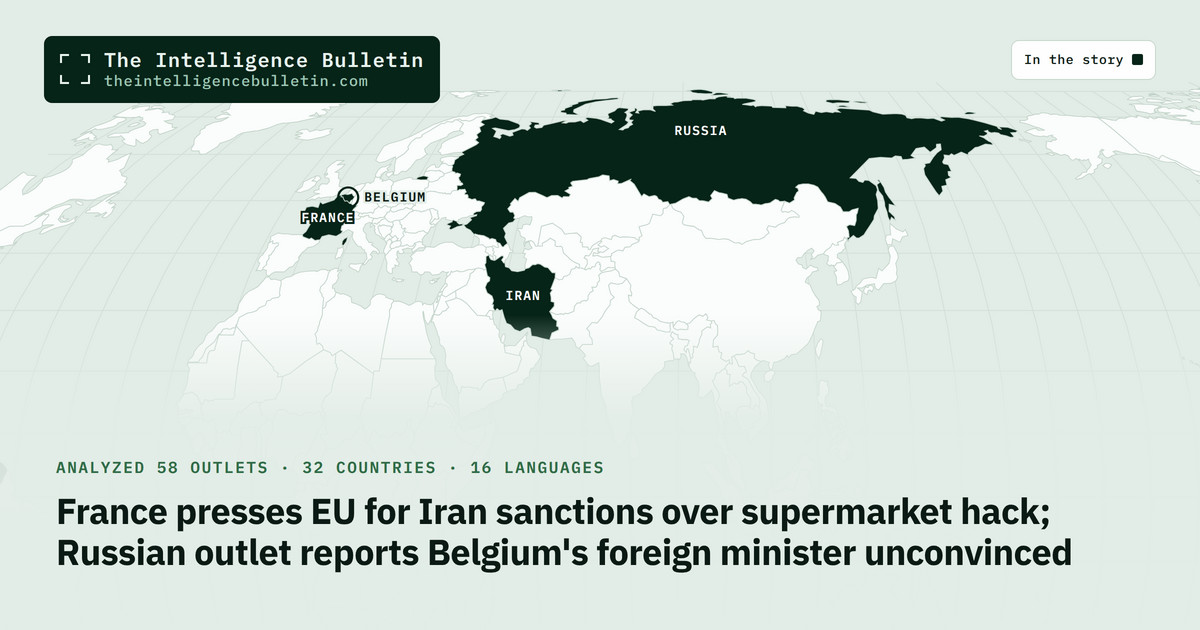
Albania, Armenia, Austria, Azerbaijan, Brazil, Bulgaria, Canada, China, Cuba, Denmark, Egypt, France, Germany, Greece, Hungary, India, Iran, Israel, Italy, Kyrgyzstan, Lebanon, Macedonia, Malaysia, Mexico, Morocco, Russia, Switzerland, Turkey, Uganda, Ukraine, United Kingdom, United States
France’s government blames an Iranian Revolutionary Guards cyber unit for sabotaging refrigeration at about 700 French sites and wants EU sanctions by December 14. Iran’s government calls the charge baseless, and the evidence shown to EU ministers has not been published.
Across the press: Only Russia’s Strategic Culture Foundation names a European doubter: Belgium’s foreign minister, whose country was also hit, calling the evidence insufficient to blame Iran.
Source base: 5 outlets read in full (France, Turkey, Germany, Russia, Israel), selected from 58 analyzed.
- Denied on the recordFrance has formally blamed Shahid Kaveh, an offensive cyber unit of Iran’s Revolutionary Guards, for the October 11-12 hack of refrigeration controllers at about 700 French retail sites.Source: French Foreign Ministry and Barrot, carried by AFP, Reuters, dpa, Anadolu and the Strategic Culture Foundation; Iran’s Foreign Ministry calls the charge ‘baseless’ and ‘ridiculous’, and IRGC spokesman Mohebbi calls it an Israeli ‘false flag’ trap.
- 1 of 5 · The Jerusalem Post onlyThe Paris prosecutor’s office has requested international arrest warrants against the leader of Shahid Kaveh and his two deputies.Reuters, carried by The Jerusalem Post, citing the Paris prosecutor’s office.
- 1 of 5 · Strategic Culture Foundation onlyBelgium’s government is split on attribution: Interior Minister Bernard Quintin says Iran is probably behind the attacks, while Foreign Minister Maxime Prévot says the available information is insufficient to formally blame Iran.Strategic Culture Foundation alone, without naming where or when the Belgian ministers spoke.
- 3 of 5 · reported separatelyThe EU is preparing new sanctions over the hack; Barrot wants a list of names within a month and hopes for adoption at the December 14 foreign ministers’ meeting, while Kallas named no targets.Barrot and Kallas in Brussels on November 16, via AFP (BFMTV), Reuters (The Jerusalem Post) and dpa (n-tv).
- 3 of 5 · reported separatelyA second wave of attacks around November 1-2 hit supermarket refrigeration in other European countries, including Belgium, Sweden and Germany, and targeted French blood banks.dpa (n-tv) names Belgium, Sweden and Germany; Reuters (The Jerusalem Post) says three French regional blood banks were hit; the Strategic Culture Foundation lists 11 countries and says staff stopped the blood-bank attempts before serious damage.
- November 25Barrot hosts an evening for Iranian civil society at the Institut du monde arabe in Paris, a sign of how hard France intends to press Tehran.
- By mid-DecemberFrance aims to have its list of Iranian names and entities to sanction ready within a month of November 16.
- December 14EU foreign ministers meet, and Barrot hopes they adopt the new sanctions; any member state that withholds support could stall them.
- Any time before December 14Belgium, Sweden, Germany or another hit country formally attributes its own incidents, which would show whether the case against Iran is more than France’s alone.
- Still openWill Belgium, Ireland, Sweden, Estonia, the Netherlands or any other country whose refrigeration systems were hacked link its own incidents to Shahid Kaveh, or does the attribution remain France s alone? · What evidence beyond Iranian IP addresses underpins the French case, and are the Cyber Avengers, Hydro Kitten and Storm 784 personas cited by Sky News Arabia s analyst actually part of the official French file?
Full analysis
What happened Why it matters How each country tells it Where accounts conflict Room for disagreement Our assessment Sources and evidence
What happened
Overnight on October 11-12, attackers took over the internet-connected controllers of supermarket refrigeration systems at about 700 retail sites across France and turned off the cold. Reuters, in copy carried by The Jerusalem Post, reports that they pushed fridge and freezer temperatures as high as 50 degrees Celsius, causing fires and spoiling stock. The French Foreign Ministry, as relayed by Anadolu Agency, described extensive damage, fires and food losses worth tens of millions of euros. Foreign Minister Jean-Noël Barrot, quoted by dpa, called it the first large-scale cyberattack for sabotage purposes on French territory, and an attack of unprecedented scale and aggressiveness.
No group claimed responsibility at the time, the Moscow-aligned Strategic Culture Foundation notes. On November 9, as TIB reported, the French Foreign Ministry named a culprit. It was Shahid Kaveh, an offensive cyber unit attached to the Revolutionary Guards’ electronic-warfare and cyber organization. Paris summoned Iran’s ambassador and said it would ask European partners to sanction the Iranian individuals and entities involved.
The Strategic Culture Foundation, quoting the ministry’s statement, adds a detail no other outlet here carries. French experts say the unit works through front groups posing as hacktivists, including CyberAveng3rs and Cyber Isnaad Front. According to that outlet, the Paris prosecutor’s office had opened an investigation into the unit. According to Reuters, the prosecutor has now requested international arrest warrants for Shahid Kaveh’s leader and his two deputies.
The attacks did not stay in France. Reuters reports that refrigerators at three French regional blood banks were hit overnight on November 1-2, while hackers struck supermarkets from Sweden to Belgium. dpa, in copy run by n-tv, names Belgium, Sweden and Germany among the countries where chilled goods had to be thrown away. The Strategic Culture Foundation counts 11 countries in that second wave, France included, adding Luxembourg, the Netherlands, Finland, Ireland, Italy, Portugal and Spain.
Tehran answered in several voices. Iran’s Foreign Ministry called the charge baseless. In a statement quoted by dpa, it described the accusation as an irresponsible and ridiculous move meant to damage Iran’s standing and its relations with other states, and said Iran would act to protect its interests. Revolutionary Guards spokesman Hossein Mohebbi wrote on X, in a post relayed by Anadolu: "Paris should beware of the Zionist regime’s false flag trap." He added that the Guards, unlike the United States and Israel, do not target civilians. Foreign Minister Abbas Araghchi, as rendered by the Strategic Culture Foundation, mocked a French government that cannot keep watch over its own refrigerators.
On November 16, Barrot took the case to Brussels. Arriving at the monthly meeting of EU foreign ministers, he said he would present evidence to his counterparts and wanted a list of new names and entities to sanction within a month, Reuters reports. AFP, carried by BFMTV, quoted him as having "bon espoir" that ministers would adopt sanctions at their December 14 meeting. It also quoted him welcoming support from "une très vaste majorité" of member states.
After the meeting, EU foreign policy chief Kaja Kallas said the attacks showed European countries are within Tehran’s reach and that the EU is preparing further sanctions. dpa reports that she did not say whom they would target, and that the new measures would add to existing EU sanctions over Iran’s nuclear program, human rights abuses and restrictions on freedom of navigation. Barrot also announced an evening for Iranian civil society at the Institut du monde arabe in Paris on November 25.
The dispute lands on a relationship that was already strained. The Strategic Culture Foundation reports that two staff of France’s diplomatic mission were detained in Tehran in July on espionage charges, and that Iran ordered the French language center in Tehran closed in September.
Why it matters
If France’s attribution holds, this was sabotage aimed at what Europeans eat and, through the blood banks, at medical supply. It was not espionage against ministries. That moves Iran’s confrontation with Europe from nuclear diplomacy and shipping lanes into grocery aisles, carried out through ordinary commercial equipment connected to the internet. The Strategic Culture Foundation, of all outlets, makes the practical point that retailers and regulators may now have to rethink the security of such industrial equipment.
The practical bite of the EU’s response is narrower than the rhetoric around it. As dpa points out, the Revolutionary Guards are already sanctioned and listed by the EU as a terrorist organization. So whatever comes on December 14 will add individuals and front entities to existing lists rather than open a new front. The Paris arrest warrants point the same way: they target three named men whose arrest depends on their leaving Iran.
The larger question is whether the attribution remains French alone. dpa counts German supermarkets among the victims, yet no German, Swedish or other government is quoted in these reports attributing its own incidents. Paris is asking capitals whose own shops were hit to endorse an assessment those governments have not made themselves.
How each country tells it
- BFMTV · France · wire copyLeads on Barrot’s hope that EU ministers adopt sanctions at their December 14 meeting and quotes him claiming support from ‘a very vast majority’ of member states, not all of them.
- Anadolu Agency · Turkey · original reportingReports the Revolutionary Guards spokesman Hossein Mohebbi’s post on X calling the French charge ‘ridiculous’ and warning Paris against an Israeli ‘false flag’ trap.
- n-tv · Germany · wire copyTreats the sanctions as an EU plan, built around Kaja Kallas’s warning after the Brussels meeting that Europe is not beyond Tehran’s reach, and notes that German supermarkets were hit too.
- Strategic Culture Foundation · Russia · opinionMocks the ‘war of the refrigerators’ as a hasty, possibly Trump-driven French accusation without technical proof, and amplifies the Iranian denials and the false-flag theory.
- The Jerusalem Post · Israel · wire copyRuns Reuters’ straight account that Barrot would present evidence to EU ministers and wants a list of new sanctions targets within a month.
Where accounts conflict
On who did it, the two accounts cannot both be true. France’s Foreign Ministry and Barrot say Shahid Kaveh carried out the attack. Their case rests on the ministry’s formal statement, the prosecutor’s action and evidence shown to EU ministers that none of the five reports describes. Iran’s Foreign Ministry calls the charge baseless, and Mohebbi calls it an Israeli false flag. Their case rests on denial; none of these reports quotes Tehran offering counter-evidence.
On Europe’s own judgment, the Strategic Culture Foundation alone reports a split inside the Belgian government. Interior Minister Bernard Quintin says security-service information suggests Iran is probably responsible. Foreign Minister Maxime Prévot says the available information is insufficient to formally blame Iran. The outlet gives no date or venue for either remark, and no Belgian outlet in this set confirms them.
On the blood banks, Reuters says they were hit, while the Strategic Culture Foundation says staff stopped the attempts before serious damage was done. Both can be true: the banks may have been attacked and the attacks contained. But the difference decides whether medical supply was actually harmed.
Room for disagreement
The strongest case against the French account is that it has not been shown in public. The attack ran through hacktivist personas built to hide who was behind them. The Strategic Culture Foundation cites independent specialists who say pinning down the real authors of such attacks is extremely difficult, and it argues that no real technical evidence exists at all. That outlet has an interest in doubting EU cyber attribution, a tool the bloc also uses against Russia.
The Belgian foreign minister’s reported hesitation, however, would come from a government whose own supermarkets were hit. And Barrot’s own "very vast majority" admits that some capitals were unconvinced. Even if sanctions pass, measures added to an organization already listed as terrorist may change little in Tehran.
Our assessment
The EU is likely to adopt new sanctions over the refrigeration attacks, though the December 14 date Barrot is hoping for is the weakest part of that call. The warrant for it is that Kallas, not just Barrot, said publicly that the EU is preparing sanctions, as both Reuters and dpa report. The bloc’s own foreign policy chief has therefore put her name to the response. The prosecutor’s request for warrants against three individuals is also a judicial act, not a diplomatic assertion.
The drag on that call is unanimity and time. One reported doubter in Belgium, and a list to be compiled within a month, leave room for slippage. Paris wants the attack read as an assault on Europe rather than on France. Tehran, and the Moscow outlet repeating its line, want it read as a political maneuver.
What would change this: a public refusal by Belgium’s foreign minister, or any other member state’s government, to endorse the French attribution before December 14 would lower the call, while another victim state formally naming Shahid Kaveh would raise it.
Sources and evidence
Press quoted
- What evidence did Barrot actually put before EU ministers on November 16, beyond naming Shahid Kaveh and its hacktivist front personas?
- Can France get the unanimity EU sanctions require when Barrot claims only ‘a very vast majority’ of member states, and does Belgium’s foreign minister still say the information is insufficient to blame Iran?
- Will Belgium, Sweden, Germany or any other country hit in the November 2 wave formally attribute its own incidents to Iran?
That’s how the world told the story.
Get our daily open-source intelligence on world events in your inbox — one email a day, up to six stories.
Subscribe freeNo spam. One-click unsubscribe. See the latest email →