 AI-generated analysis published under the editorial responsibility of Rohit Sinnas. How it works →
See the 52 countries
Afghanistan, Argentina, Armenia, Australia, Austria, Bangladesh, Barbados, Brazil, Bulgaria, Canada, China, Croatia, Egypt, Finland, France, Germany, Greece, Hungary, India, Indonesia, Iran, Iraq, Israel, Italy, Jordan, Kenya, Latvia, Lebanon, Malaysia, Morocco, Netherlands, New Zealand, Nigeria, Philippines, Poland, Qatar, Russia, Serbia, Somalia, South Korea, Sri Lanka, Sweden, Switzerland, Syria, Taiwan, Tunisia, Turkey, Tuvalu, Ukraine, United Arab Emirates, United Kingdom, United States
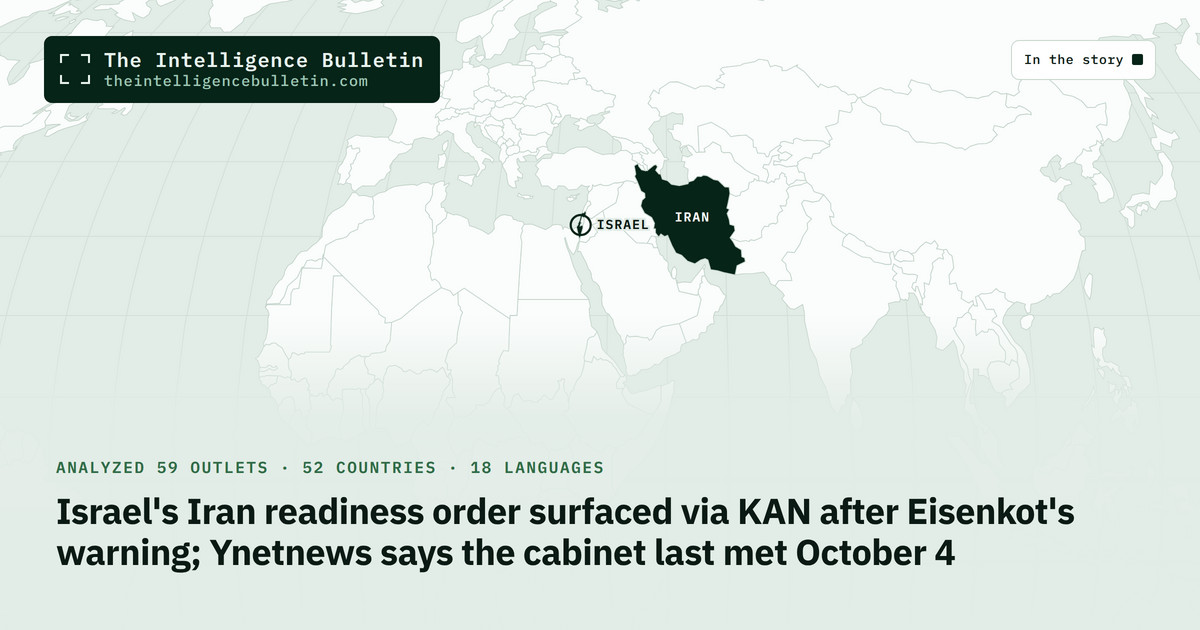
Israel’s Security Cabinet has directed the military to raise readiness for Iran scenarios including an Israeli strike, but Ynetnews dates that decision to October 4. Eisenkot’s bloc says Netanyahu is pushing a strike over IDF objections; Netanyahu’s office denies it. The cabinet meets Sunday.
Across the press: Al Jazeera, relaying KAN, ran the cabinet’s Iran readiness order as Wednesday news; Ynetnews reports the cabinet raised preparedness October 4 and hasn’t met since.
Source base: 5 outlets read in full (Israel, Qatar, Jordan, Germany, United Arab Emirates), selected from 59 analyzed.
- Denied on the recordNetanyahu has been pushing for military action against Iran despite opposition from IDF Chief of Staff Eyal Zamir and other senior defense officials.Source: Unnamed senior figures in Eisenkot’s bloc, via Ynetnews; Der Spiegel calls these unconfirmed media reports. Netanyahu’s office says all decisions were made ‘in full coordination with the security establishment.’
- Denied on the recordA weekend phone call between Netanyahu and Trump over resuming strikes on Iran was exceptionally confrontational, with extensive shouting.Source: Ynetnews, citing a source familiar with the call and US officials. Netanyahu’s office insists the conversation went well.
- 1 of 5 · Al Jazeera onlyIran’s Mohsen Rezaei warned that if the US launches another war, every base involved ‘from West Asia to Europe’ will be a legitimate target.Al Jazeera, quoting Rezaei’s social media post.
- 2 of 5 · reported separatelyIsrael’s Security Cabinet has directed the military to raise readiness for Iran scenarios that include an Israeli strike.Al Jazeera, citing KAN, reports it as a fresh order disclosed on Wednesday. Ynetnews reports the cabinet took a decision to increase preparedness at its October 4 meeting and has not met since.
- 4 of 5 · reported separatelyEisenkot, now tasked with forming a government, sent Netanyahu a formal letter demanding he not deploy security forces without a ‘direct and immediate threat’ until a new government is sworn in.Eisenkot’s own letter, published on X, carried by Ynetnews, Al Jazeera, Der Spiegel and Ammon News (via Al Arabiya).
- Sunday, November 15The Security Cabinet holds its first meeting since October 4, the body whose approval Israeli law requires for any war or major operation.
- Week of November 16The Knesset Foreign Affairs and Defense Committee may convene, restoring parliamentary oversight that Eisenkot accuses Netanyahu of delaying.
- AnsweredYes: Al Jazeera reports Herzog offered Eisenkot the chance to form a government over the weekend, and Ynetnews describes him as tasked with forming the next government.
- Still openCan Eisenkot convert 67 recommendations into a 61-seat confidence vote, given Yisrael Beiteinu s refusal to join a government reliant on Arab parties and the Joint List s preference for external support rather than joining? · What happens if Eisenkot fails to form a coalition within the 28-day window — will Netanyahu get a chance, or will Israel face another election?
- 08 Nov · Ya Libnan, Akhbarona and AFP s Gulf News copy call Eisenkot successor; Jerusalem Post, Algemeiner say 61 seats still missing
- 06 Nov · Ynet and n-tv headline Eisenkot s 67-46 edge as settled; Chile s BioBioChile leads with Herzog s not entirely clear
- 10 Nov · Trump, after Qatar talks, says new Iran strikes quite unlikely — but only Doha hears effectively over
- 10 Nov · US pulls aircraft from second UK base over Iran threat as outlets split on which bases are under alert
Full analysis
What happened Why it matters How each country tells it Where accounts conflict Room for disagreement Our assessment Sources and evidence
What happened
On Wednesday evening, November 11, Israel’s public broadcaster KAN reported that the Security Cabinet, which Prime Minister Benjamin Netanyahu chairs, had directed the military to step up preparations for a possible attack on Iran. "The directives issued by the security cabinet to the Israeli military could lead it to carry out activities that could trigger a war," KAN said, in reporting relayed by Al Jazeera. KAN added a detail that matters more than the headline. The directives were made public only after Gadi Eisenkot, the man now trying to replace Netanyahu, wrote to him that day.
Whether this is a new order is the first thing to settle, and the reporting points toward no. Ynetnews reports that the Security Cabinet has not convened since October 4, in the middle of the election campaign. At that meeting, ministers decided to raise military preparedness for several Iran scenarios, including a potential Israeli strike and a surprise Iranian attack. The cabinet’s next meeting, its first in more than a month, is set for Sunday. No outlet here reports a session in between. Read alongside KAN’s own phrase, "made public," the account that fits all of the reporting is an October decision disclosed this week.
It was disclosed in the middle of a fight over who governs. President Isaac Herzog tasked Eisenkot with forming a government over the weekend; TIB reported on November 8 that 67 of the Knesset’s 120 members had recommended him. The 26th Knesset was sworn in on Tuesday, leaving Netanyahu as caretaker. In a formal letter he published on X, Eisenkot reminded Netanyahu that "only 46 members of Knesset still support your continued tenure." He cited "deeply troubling reports" of "ulterior considerations" entering security decisions. He warned that deploying forces "in the absence of a direct and immediate threat that cannot be postponed could have devastating consequences for Israeli democracy." Ammon News, carrying Al Arabiya’s account, notes that he named no specific operation and gave no detail of the reports he cited. He separately asked Attorney General Gali Baharav-Miara to intervene, saying his team’s attempts to arrange security briefings had failed. Because Yair Lapid’s term as opposition leader ended on Tuesday, Eisenkot argued, the briefings should now come to him.
Senior figures in his bloc spelled out those reports to Ynetnews. They say Netanyahu has pressed for military action against Iran over the objections of IDF Chief of Staff Eyal Zamir and other senior defense officials, and that Washington has blocked him at least once. One accused him of having "gone off the rails" in an effort to run down Eisenkot’s coalition clock. Netanyahu, for his part, told the Knesset that "the only way to permanently eliminate this existential threat is to overthrow the mullah regime." His office called Eisenkot’s letter "a transparent attempt to politicize Israel’s national security issues" and said every decision was made "in full coordination with the security establishment."
Tehran’s voice enters this story through one outlet. Al Jazeera quotes Mohsen Rezaei, whom it calls Iran’s security chief: "If the US launches another war against Iran, every military base involved in the aggression, from West Asia to Europe, will be a legitimate target." As quoted, the threat is addressed to Washington. Al Jazeera’s Tehran correspondent reports that the leadership is weighing Rezaei as its chief negotiator. He also reports that some voices in Tehran say Iran "might take pre-emptive action" if the "no war, no peace" standoff drags on. On the same day, Tehran rejected a US proposal to move its stockpile of 60 percent enriched uranium to a third country, and Brent crude settled $1.27 higher at $92.76. Separately, Gulf News reports that Central Command said in a November 11 statement that it is extending its blockade pressure to Iran’s land borders and the Caspian Sea.
Why it matters
Israeli law gives this decision to a body, not to one man. Section 40 of Basic Law: The Government, as Ynetnews lays it out, requires the government or the Security Cabinet to authorize a war or an operation likely to lead to one. It makes no exception for a caretaker government, which makes Sunday’s meeting the gate. The checks around that gate are thin. The Foreign Affairs and Defense Committee has not yet been formed, and there is no designated opposition leader to receive classified briefings. Eisenkot asks why Netanyahu is trying to delay convening the committee until next week.
The stakes reach beyond Israel. Eisenkot’s bloc fears that a war would swallow his 28-day mandate. Rezaei’s threat covers bases as far away as Europe, where TIB reported on November 10 that the US had already moved refueling aircraft out of RAF Mildenhall. A unilateral Israeli strike that Washington had opposed would test whether Tehran’s distinction between a US war and an Israeli one holds.
How each country tells it
- Ynetnews · Israel · original reportingTreats the Iran question as a fight inside Israel over whether a caretaker prime minister can take the country to war. It sets the opposition bloc’s charge that Netanyahu is pushing a unilateral strike over IDF chief Zamir’s objections against Section 40 of the Basic Law, the 2021 and 2022 caretaker precedents and a reported ‘shouting match from hell’ with Trump.
- Al Jazeera · Qatar · carries KANLeads with Tehran’s threat to widen the war and presents the Israeli readiness order, sourced to public broadcaster KAN, as Wednesday-evening news. It adds its own correspondents in Tehran and Washington and an exclusive interview with Ghalibaf.
- Ammon News · Jordan · carries Al ArabiyaGives a straight account of Eisenkot’s letter to Netanyahu: a demand for restraint, a warning against using security forces without an immediate threat, and a warning against a constitutional clash with security chiefs.
- Der Spiegel · Germany · carries The Times of IsraelFrames Eisenkot’s letter as a warning against unilateral military action. It calls the reports that Netanyahu seeks a renewed strike over military objections ‘unconfirmed media reports’.
- Gulf News · United Arab Emirates · original reportingThe headline promises a roundup of Iranian threats to US bases, Houthi missile debris over Makkah and Eisenkot’s caution to Netanyahu. The fetched text, however, covers only CENTCOM’s widening blockade of Iran’s land and Caspian supply routes and Task Force Iron Gate.
Where accounts conflict
The accounts differ on timing. Al Jazeera, relaying KAN, presents the order as Wednesday-evening news, based on the content of the directives. Ynetnews rests on the cabinet calendar. The two accounts can both stand only if the directives KAN described are the October ones.
They differ on the Trump call. A source familiar with the weekend call and US officials described it to Ynetnews as exceptionally confrontational, "a shouting match from hell." Netanyahu’s office insists the conversation went well.
They differ on the military’s position. The charge that Zamir opposes a strike comes only from Eisenkot’s bloc, and Der Spiegel calls such reports unconfirmed. Netanyahu’s office denies any rift.
They differ on briefings. Eisenkot says his request through official channels was refused, while Netanyahu’s office says it invited him before he asked.
Room for disagreement
The case that a strike comes anyway is serious. The law permits a caretaker cabinet to authorize one, and precedent shows caretakers acting. Netanyahu fought the 11-day Gaza war of 2021 as caretaker. In 2022, Lapid’s caretaker government launched Operation Breaking Dawn, mobilizing 25,000 reservists without convening the cabinet. Al Jazeera reports that Netanyahu is adamant the war continues until the government in Tehran collapses. Trump, according to Al Jazeera, has said he is prepared to return to war if Qatar’s diplomatic track fails, and Tehran has just rejected the uranium proposal. The October directive also covered a surprise Iranian attack. If the voices for pre-emption win out in Tehran, Eisenkot’s own standard of a "direct and immediate threat" would be met.
Our assessment
An Israeli strike on Iran before a new government is sworn in is unlikely. On the best reading, the readiness order is an October preparedness decision rather than an instruction to launch. The step that would turn it into one, a Security Cabinet authorization, has not happened. Washington’s position is on the record. TIB reported Trump calling new strikes "quite unlikely" on November 10, and Al Jazeera reports Secretary of State Marco Rubio saying that economic pressure makes renewed large-scale operations unnecessary. The claim that Zamir objects comes from a bloc with every interest in portraying Netanyahu as reckless, and Netanyahu’s office has every interest in denying it. That claim deserves little weight either way, but the US stance does not depend on it. The reader should also know about one gap: no Iranian or American outlet is in this source set. How Tehran would read a strike by Israel alone therefore rests on a single quoted post.
What would change this: a Security Cabinet vote on Sunday authorizing an operation, or a collapse of the Qatari track that removes Washington’s objection.
Sources and evidence
Press quoted
- Did Israel’s Security Cabinet issue any new directive on Iran, or is the order KAN disclosed the preparedness decision Ynetnews dates to October 4, made public only after Eisenkot’s letter?
- What will the Security Cabinet authorize when it meets on Sunday, and will IDF chief Zamir’s reported objection hold if it approves action?
- Has Washington actually blocked an Israeli strike, as Eisenkot’s bloc claims, and will the attorney general force Netanyahu’s office to brief Eisenkot?
That’s how the world told the story.
Get our daily open-source intelligence on world events in your inbox — one email a day, up to six stories.
Subscribe freeNo spam. One-click unsubscribe. See the latest email →