 AI-generated analysis published under the editorial responsibility of Rohit Sinnas. How it works →
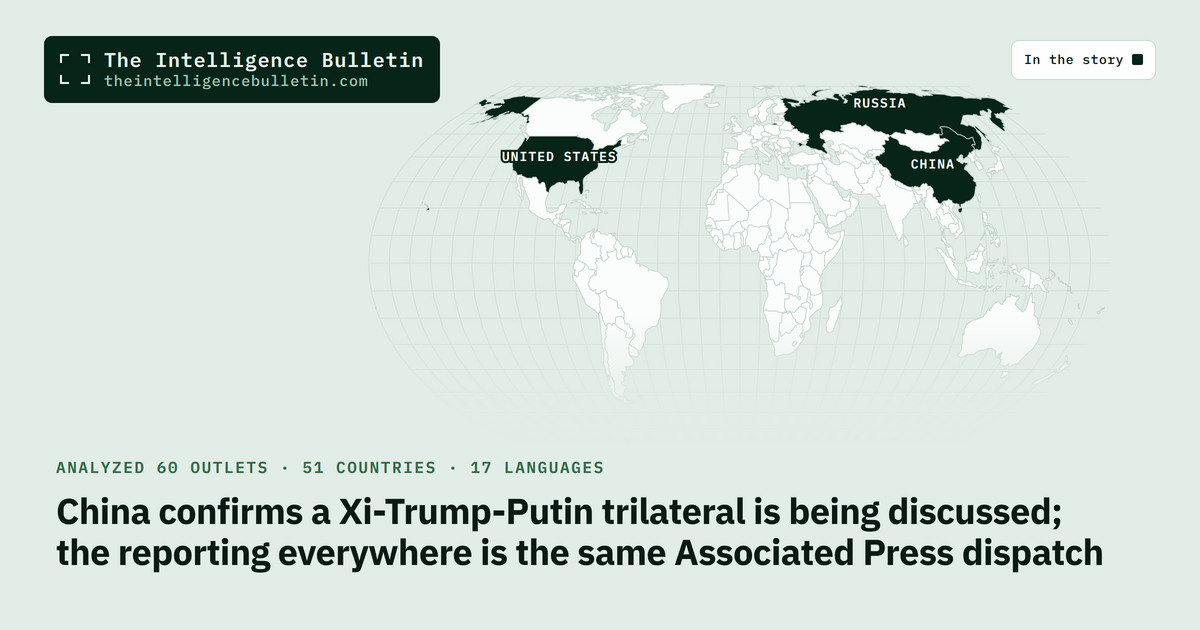
See the 51 countries
Afghanistan, Albania, Armenia, Azerbaijan, Bangladesh, Belgium, Bulgaria, Burundi, China, Croatia, Cuba, Cyprus, Czech Republic, Egypt, Finland, Greece, Hungary, India, Indonesia, Ireland, Israel, Italy, Kazakhstan, Kenya, Latvia, Malawi, Malaysia, Netherlands, New Zealand, Nigeria, Oman, Philippines, Poland, Qatar, Romania, Russia, Serbia, Slovakia, Slovenia, South Africa, Spain, Sri Lanka, Sweden, Switzerland, Syria, Taiwan, Turkey, Ukraine, United Kingdom, United States, Zimbabwe
China’s foreign ministry has confirmed for the first time that Beijing is in communication about a Xi-Trump-Putin meeting, which could occur this month at APEC in Shenzhen; nothing is set, and analysts expect a choreographed photo opportunity with Russia pushing hardest for it.
Across the press: Three outlets carry the same Associated Press dispatch and Adevărul repeats its expert quotes via The Independent, leaving China and Russia nearly voiceless.
Source base: 5 outlets quoted (China, United States, Ukraine, India, Romania), selected from 60 analyzed. 4 read in full, 1 by its headline only.
- 3 of 5 · one shared reportUSTR Jamieson Greer, in a Friday video call with Chinese Vice Premier He Lifeng, urged concrete implementation of agricultural, rare-earth and critical-mineral commitments; Xinhua called the exchange in-depth and constructive.AP, quoting a statement from Greer’s office and reporting Xinhua’s Saturday account.
- 4 of 5 · reported separatelyBeijing confirmed for the first time that it is in communication about a trilateral Xi-Trump-Putin meeting.AP, citing Chinese foreign ministry spokesperson Mao Ning at a Beijing press briefing; Adevărul reports the same statement via The Independent.
- 4 of 5 · reported separatelyAny trilateral would take place this month on the sidelines of the APEC leaders’ summit in Shenzhen, which China hosts, though nothing is set.AP; the same hosting detail appears in The Independent via Adevărul.
- 4 of 5 · reported separatelyExperts expect the meeting to be choreographed as a photo opportunity with little substantive outcome because the three powers’ interests are at odds; Sun Yun says China wants the image but not the costs.AP quoting Stimson Center China program director Sun Yun; Adevărul relays the analyst expectation via The Independent.
- 4 of 5 · reported separatelyPutin has the most to gain from a leaders’ trilateral and the Russians are clearly behind the push, while Trump’s advisers have warned him to steer clear of Ukraine as a topic.Danny Russel, former senior State Department official now at the Asia Society Policy Institute, quoted in AP and relayed by The Independent via Adevărul.
- 18–19 November, APEC summit in ShenzhenWhether the leaders’ program names a trilateral, or Beijing keeps only separate Xi-Trump and Xi-Putin bilaterals.
- Still openHas Beijing actually agreed to a trilateral, or is it keeping open the option of separate Xi-Trump and Xi-Putin bilaterals? · What agenda could all three accept, given Beijing rejects trilateral nuclear arms control talks and reportedly wants Ukraine left to Europeans?
Full analysis
What happened Why it matters How each country tells it Room for disagreement Our assessment Sources and evidence
What happened
Beijing confirmed this week, on the record for the first time, that it is in communication about a trilateral meeting of Xi Jinping, Donald Trump and Vladimir Putin. Mao Ning, the foreign ministry spokesperson, said at a Beijing briefing that China "is in communication with relevant parties regarding a meeting between the three heads of state," the Associated Press reported. Nothing is set. If it happens, it would come this month on the sidelines of the Asia-Pacific Economic Cooperation leaders’ summit in Shenzhen, which China hosts; the 21-member grouping includes the U.S. and Russia, and TIB reported on 4 November that the summit itself falls on 18–19 November, that Kremlin spokesman Dmitry Peskov says work is under way, and that both Putin and Trump have said they would attend.
Trump is expected in Shenzhen for a third meeting with Xi this year, holding together a trade truce that expires in January. Tensions persist: U.S. Trade Representative Jamieson Greer, in a Friday video call with Vice Premier He Lifeng, urged "concrete actions to fully implement its past commitments, particularly as they relate to agricultural purchases, rare earths, and other critical minerals," according to a statement from Greer’s office quoted by AP; the wire also relays Xinhua’s Saturday description of the call as in-depth and constructive, with Chinese concerns raised over U.S. trade restrictions.
On substance, the experts AP quotes converge on one forecast: a choreographed photograph, not a negotiation. "I think it will happen. The question is the format and the content," said Sun Yun, director of the Stimson Center’s China program, whose read is that "China wants the image but not the costs." Beijing would stage the picture without signing on to arms-control talks or discussions of Ukraine or Iran beyond a peace refrain, and would have to manage what she calls "Russian manipulation." Danny Russel, a former senior State Department official at the Asia Society Policy Institute, put the motive on Moscow: "Putin has the most to gain from a leaders’ trilateral, and the Russians are clearly behind the push for a meeting, which would be a diplomatic coup." Trump, with his "crush on authoritarian strongmen," would love it too, but his advisers have warned him to steer clear of Ukraine. Craig Singleton of the Foundation for Defense of Democracies saw "no more than a photo opportunity" with "diminishing diplomatic returns." Sun’s warning was pointed: the summit "should not be equated to three great powers dividing up the world."
That last phrase is where the wire’s neutral register gives way to national stakes. Ukraine’s Obozrevatel reprints the AP account but frames the question as whether the meeting will happen, because for Kyiv the answer is the shape of its war; it calls Putin the "Russian dictator" and appends its earlier OBOZ.UA warning that the three leaders could "change the world order and divide the planet into spheres of influence." Romania’s Adevărul, carrying the same quotes via The Independent, stresses the NATO frontier stake — a great-power bargain struck over Europe’s head — and adds that Putin proposed the trilateral in a 9 October call with Trump to negotiate Ukraine’s four-year war on terms Wall Street Journal sources said could favor Moscow. TIB noted on 4 November that Beijing’s position was already contested: Hindustan Times reported a confirmed summit, while Chosun Biz said the ministry mentioned only a China-Russia meeting — an ambiguity the "in communication" wording does not resolve.
Why it matters
A first trilateral among the three leaders would be staged on the fault line of the current order: Ukraine, Taiwan, nuclear arms control and the apportionment of influence all run through that table. The reporting’s own forecast is that the event would change almost none of them substantively — the prize is the image, and the image is not neutral. For Moscow, as Russel put it, the photograph is the coup: Putin standing beside Xi and Trump after years of Western effort to isolate him, discussing Ukraine without Kyiv in the room. For Beijing, per Sun Yun, it is a perception problem, the host wanting the picture of great-power management without being accused of dividing up the world. For Washington, the advisers’ instruction to keep Trump away from Ukraine is a plan to limit damage rather than extract a result.
What the reader can take from this edition is also a finding about how the story traveled. Three outlets — the Boston Herald, India’s Daily Excelsior and Ukraine’s Obozrevatel — publish the same Associated Press dispatch, and Romania’s Adevărul carries the same Sun Yun and Russel quotations through The Independent. The only Chinese item in the set is a commentary headline whose text could not be read, and no Russian outlet appears. So the two powers whose leaders would sit at that table are nearly voiceless in the coverage TIB could assemble; the Ukrainian and Romanian relays add their audiences’ stakes — spheres of influence, a settlement over Europe’s head — but no new reporting of their own.
How each country tells it
- ChinaTechNews · China · opinionA host-side weighing of what a Trump-Xi-Putin summit could and could not deliver for Beijing, framed as analysis rather than straight confirmation.
- Boston Herald · United States · wire copyThe neutral Associated Press confirmation that Beijing is in communication about a trilateral, with experts casting the likely meeting as a photo opportunity.
- Obozrevatel · Ukraine · carries Associated PressA Ukrainian mass-audience newsroom leading on whether the meeting will actually happen, because for Kyiv the answer is not diplomatic colour but the shape of its war.
- dailyexcelsior.com · India · wire copyThe AP confirmation carried under an Indian masthead, presenting the trilateral as a headline diplomatic development without adding an Indian strategic reading.
- Adevărul · Romania · carries The IndependentA European frontier-state framing of what is at stake in a three-way summit China is preparing, stressing the risk of a great-power bargain struck over Europe’s head.
Room for disagreement
The strongest case against the "photo opportunity" conclusion is that the photograph is itself the strategic result, and the people with most to lose say so. Obozrevatel’s appended warning, published before this week’s confirmation, is that the three leaders could "change the world order and divide the planet into spheres of influence" — a far heavier read than a photo op — grounded in Moscow’s proposal and Washington’s shifting Ukraine and Europe policy. Adevărul makes the same case from the European side: a trilateral born of Putin’s 9 October proposal to negotiate Ukraine’s future could lock in terms favorable to Moscow whatever the official agenda. On that reading, calling a Putin appearance beside Xi and Trump merely symbolic understates what it delivers to Moscow, and the "diminishing diplomatic returns" Singleton warns of may not diminish fast enough for Kyiv or for Europe.
Our assessment
The meeting is likely to happen this month in Shenzhen, staged as a photograph without the substance. The warrant is the convergence of the reporting: AP and The Independent’s relay carry the same on-record expert expectation — Sun Yun says outright she thinks it will happen, with the format and content unresolved — and no quoted voice predicts otherwise; Putin and Trump have both said they would attend, and Beijing’s first-time confirmation of "communication" is the clearest sign yet that the host intends to stage it, the "image but not the costs" calculation. Each party has a reason to keep the format small rather than cancel — Beijing collects the picture, Moscow the legitimizing photograph, Washington keeps Trump away from Ukraine — and none has an interest in widening the agenda to arms control or the war.
What would change this: a Beijing statement before the summit confining the Shenzhen program to separate Xi-Trump and Xi-Putin bilaterals, which would keep the trilateral from happening at all.
Sources and evidence
Press quoted
- Has Beijing committed to a leaders’ trilateral, or is ‘in communication’ a way to keep separate Xi-Trump and Xi-Putin bilaterals open?
- Are Trump, Xi and Putin all confirmed to attend APEC in Shenzhen, and would a trilateral be a formal meeting or an informal encounter?
- What agenda could all three accept if Trump wants nuclear arms control and Putin wants Ukraine without Kyiv, while Sun Yun says China would refuse those topics?
That’s how the world told the story.
Get our daily open-source intelligence on world events in your inbox — one email a day, up to six stories.
Subscribe freeNo spam. One-click unsubscribe. See the latest email →