 AI-generated analysis published under the editorial responsibility of Rohit Sinnas. How it works →
See the 44 countries
Australia, Austria, Azerbaijan, Belarus, Brazil, Canada, China, Czech Republic, Denmark, Finland, France, Germany, Greece, India, Ireland, Israel, Japan, Jordan, Kazakhstan, Kyrgyzstan, Latvia, Lithuania, Macedonia, Netherlands, Nigeria, Niue, Norway, Poland, Qatar, Romania, Russia, Saudi Arabia, Serbia, Singapore, Spain, Suriname, Sweden, Switzerland, Thailand, Turkey, Tuvalu, Ukraine, United Kingdom, United States
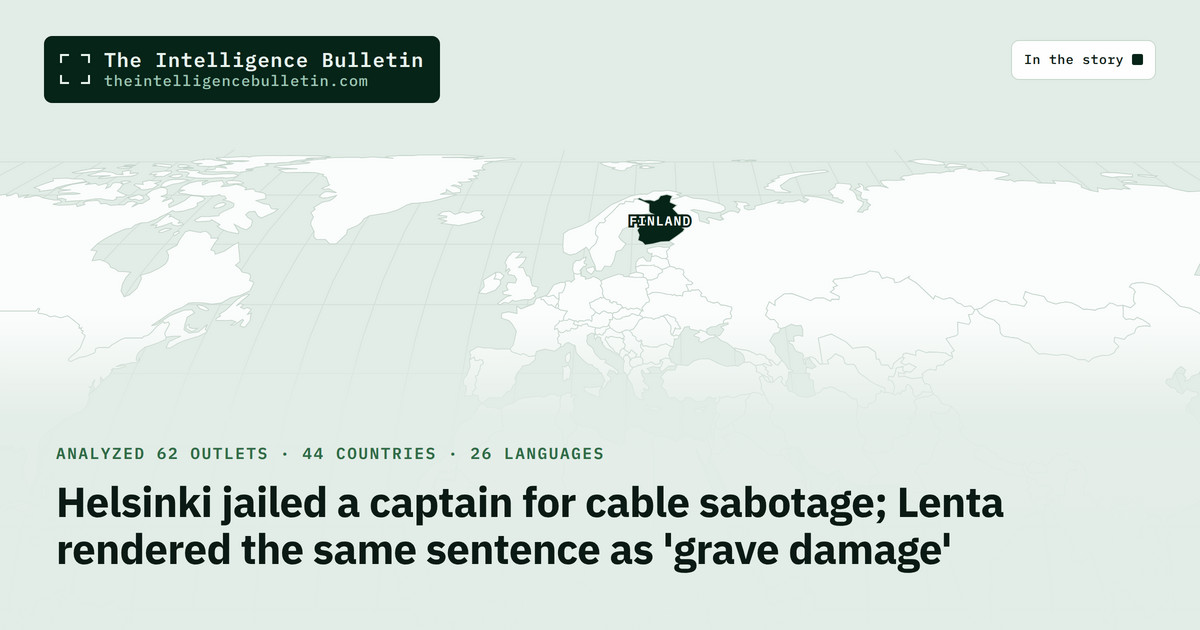
Helsinki District Court sentenced Fitburg captain Andrei Maksimenko to three and a half years and boatswain Vusal Majidov to two years and ten months for aggravated sabotage of Finland-Estonia cables. Both deny the charges and can appeal; APA says the captain plans to.
Across the press: Yle and APA both reported sabotage; Lenta’s report of the same verdict never used the word, saying ‘grave damage’ instead.
Source base: 5 outlets read in full (Finland, Russia, Latvia, Azerbaijan, Ukraine), selected from 62 analyzed.
- 2 of 5 · one shared reportThe court ruled the two men must have known the anchor was down while the ship moved at sea for about 130 kilometres over several hours, making the offences intentional and giving Finland jurisdiction.Yle reports the court’s ruling; LSM relays it citing Yle and adds that the investigation found the anchor mechanism functional and that the anchor was raised only after Finnish authorities alerted the ship.
- 5 of 5 · reported separatelyHelsinki District Court sentenced the Fitburg’s captain Andrei Maksimenko to three years and six months in prison for aggravated sabotage.Yle reports the court ruling; Lenta.ru, LSM and Glavkom relay it citing Yle, and APA relays it citing Euronews.
- 4 of 5 · reported separatelyThe Azerbaijani boatswain Vusal Majidov was sentenced to two years and ten months in the same case.Yle names him and gives the sentence; Lenta.ru and LSM relay it via Yle; APA relays the sentence for the Azerbaijani national via Euronews without naming him.
- 4 of 5 · reported separatelyThe ship dragged its anchor across the seabed, severing two subsea telecommunications cables between Finland and Estonia and risking seven further cables and a gas pipeline.Yle reports the court’s findings; LSM and Glavkom relay them citing Yle; APA carries the two Finland-Estonia cables via Euronews.
- 3 of 5 · reported separatelyThe court ordered both men to jointly pay compensation for cable and pipeline repairs and investigation costs, about €1.9 million, and remanded them into immediate custody.Lenta.ru and LSM relay a Yle report of the compensation and immediate-custody orders; APA relays Euronews for the €1.9 million figure.
- The appeal window, yet to be announcedThe captain is reported to be planning an appeal, and an appellate panel will rule on Finland’s jurisdiction over damage found mostly in Estonia’s exclusive economic zone.
Full analysis
What happened Why it matters How each country tells it Where accounts conflict Room for disagreement Our assessment Sources and evidence
What happened
On 5 November, Helsinki District Court sentenced two merchant seamen to prison for dragging their ship’s anchor across the Gulf of Finland seabed. The Fitburg’s Russian captain, Andrei Maksimenko, received three years and six months; its Azerbaijani boatswain, Vusal Majidov, two years and ten months — both for aggravated sabotage, and both named by Yle, the Finnish public broadcaster, which says it is naming them because the case is of significant public interest.
The offences happened on the morning of 31 December 2025, while the Fitburg was under way from St Petersburg to the Israeli port of Haifa. According to the court’s findings as reported by Yle, the ship dragged its anchor along the seabed for about 130 kilometres over several hours, severing two subsea telecommunications cables between Finland and Estonia and putting a further seven cables and a gas pipeline at risk. Latvia’s LSM, relaying Yle, adds that the investigation proved the anchor’s fixation mechanism was in working order and that the anchor was raised only after Finnish authorities noticed the drag and alerted the ship — a detail that refutes the defence claim, carried by Ukraine’s Glavkom, that the anchor was faulty and the crew followed the Finnish coast guard’s instructions. Glavkom also reports investigators matched the drag track to the ship’s route and obtained video of the anchor chain being raised.
Both men denied the charges and asked the court to dismiss them. The court nonetheless ruled the two must have known the anchor was down while the ship moved at sea over that distance and hours, making the offences intentional and establishing Finnish jurisdiction. It ordered both into immediate custody and to jointly pay for cable and pipeline repairs and investigation costs; Azerbaijan’s APA puts the compensation at approximately €1.9 million, relaying Euronews. LSM reports the sentence went beyond what the prosecution requested: two years and six months for each. The ruling is not final and can be appealed, and APA reports the captain is planning to appeal. The Fitburg is a 132-metre cargo ship flying the flag of St Vincent and the Grenadines, with a crew of 14 that included eight Russians; the ship itself left Finland in January, but several crew members were banned from leaving, LSM notes.
The case sits inside a pattern that has repeatedly punctured the Baltic over the past two years. Yle notes the Fitburg case has striking similarities with the Eagle S, the vessel suspected of damaging cables over Christmas 2024. LSM supplies the fuller geography: the EstLink 2 power link damaged in December 2024, two cables cut in Swedish territorial waters in November 2024, the NATO operation Baltic Sentry launched in January 2025, and damage to Latvia’s own undersea fibre cable in January 2026.
Why it matters
The sentence marks the point where accountability for hybrid infrastructure attacks becomes individual prison time rather than detentions and sanctions. Two named men will serve years and jointly pay around €1.9 million. Just as consequential is the court’s reasoning on its own authority: Finland could try the case, Yle reports, because the offences were intentional and their effects were felt in Finland, even though Glavkom reports the damage lay mostly in Estonia’s exclusive economic zone. That is a jurisdiction finding written for a shadow fleet that has made the anchor-drag a technique. And because the conviction is for aggravated sabotage rather than an accident of navigation, the court has fixed in law what the defendants contest: that the cable cuts were an act a person chose. Yet the verdict reaches only the hands, not the operators who direct them — the shadow fleet’s owners and hirers were never before this court — and the two seamen’s appeals remain.
How each country tells it
- yle.fi · Finland · original reportingThe Finnish public broadcaster’s English service reports the Helsinki District Court ruling as a domestic criminal-justice outcome, naming both defendants for public interest and detailing the court’s findings on jurisdiction, intent and the 130-kilometre anchor drag without geopolitical framing.
- Lenta.ru · Russia · carries YleThe most deflationary framing in the set: the headline records only that a verdict was handed down, with the words guilt and sabotage never appearing, while the text relays Yle’s conviction details and renders the charge as grave damage rather than sabotage.
- LSM (Latvijas Sabiedriskie Mediji) · Latvia · carries YleLatvia’s public broadcaster frames the verdict as a regional security precedent for undersea infrastructure, using it to open an extensive context on the shadow fleet, EstLink 2, NATO’s Baltic Sentry and the damage to Latvia’s own cable.
- APA News Agency (Azeri-Press) · Azerbaijan · carries EuronewsBaku’s agency leads with its own citizen, the Azerbaijani boatswain sentenced to two years and ten months, and is the only source carrying the approximately €1.9 million joint compensation figure, relaying Euronews.
- Glavkom · Ukraine · carries YleUkraine’s outlet reads the verdict as hybrid-war accountability, a Russian captain actually jailed for infrastructure sabotage, and supplies evidentiary detail: video of the anchor chain being raised, a drag track matching the ship’s route, damage mostly in Estonia’s EEZ, and EU envoy Kaja Kallas thanking Finland.
Where accounts conflict
The sharpest divergence is what the men were convicted of, in the words each outlet chose. Yle reports ‘aggravated sabotage’; APA, relaying Euronews, writes of ‘the sabotage of undersea cables’; Glavkom renders the charge as deliberate damage to underwater infrastructure and disruption of telecom networks. Lenta, Russia’s state-aligned outlet, renders the charge as ‘тяжкое причинение ущерба’ — grave causing of damage — and its article never uses the word sabotage. A Russian reader is handed a different offence in the same sentence. The second conflict is carried piecemeal between the defence and the court. Glavkom alone reports the defence argument that the anchor was faulty and the crew followed Finnish coast guard instructions; LSM alone reports the investigation’s finding that the mechanism was functional and raised only after Finnish authorities alerted the ship; Yle carries the court’s answer — the men must have known the anchor was down over 130 kilometres and hours. No single article in the set lays out all three.
Room for disagreement
The strongest case against the verdict holding is that it rests on a novel jurisdiction claim and is under appeal. Yle notes the ruling is not final; APA reports the captain plans to appeal. Glavkom carries the defence argument that the anchor was faulty and the crew followed Finnish coast guard instructions, and that the damage lay mostly in Estonia’s exclusive economic zone. If an appellate court reads the territorial question differently, the conviction falls before the facts are examined. The sentence’s excess over the prosecution’s request, reported only by LSM, gives the defence one more argument to make. And the men in the dock are the hands, not the operators — convicting a captain and a boatswain has not touched the shadow fleet’s owners, who were never before this court. Baltic cable security does not rest on two seamen.
Our assessment
The conviction is likely to survive the appeals both defendants have signalled. The evidence of intent converges across independent reporting chains: Yle’s court finding that the men must have known the anchor was down over a 130-kilometre, hours-long drag; LSM’s investigation detail that the mechanism was functional and raised only after Finnish authorities alerted the ship; Glavkom’s drag-track match and video evidence. The defence’s only technical counter — a faulty anchor — is answered by the investigation’s finding that it worked, and the two men have every incentive to claim an accident while the prosecution has followed the evidence to intent. The jurisdiction claim is the one live risk: a court that reached over damage mostly in Estonia’s waters has handed the appeal a question, and the sentence beyond the prosecutor’s request, reported only by LSM, gives the defence another argument. Neither touches the facts, and the facts are what an appellate panel will weigh against the government’s evidence.
What would change this: an appellate finding that the damage’s location mostly in Estonia’s exclusive economic zone leaves the offences outside Finnish jurisdiction would overturn the conviction without a word on the merits.
Sources and evidence
Press quoted
- Will the convictions stand on appeal, given the captain is reported to be appealing, the defence insisted the anchor was faulty and the crew followed Finnish coast-guard instructions, and LSM reports the court imposed more than the prosecutor’s requested two years and six months?
- What does this verdict mean for the parallel Eagle S case and for future shadow-fleet prosecutions, when the Fitburg conviction establishes individual intent but none of the reporting links the two men to a state or organisational chain of command?
- Does accountability for Baltic cable damage end with these two crew members, or is there any investigation into the ship’s owners and operators, given no source reports charges or inquiries beyond the captain and boatswain?
That’s how the world told the story.
Get our daily open-source intelligence on world events in your inbox — one email a day, up to six stories.
Subscribe freeNo spam. One-click unsubscribe. See the latest email →