 AI-generated analysis published under the editorial responsibility of Rohit Sinnas. How it works →
See the 51 countries
Algeria, Argentina, Austria, Azerbaijan, Benin, Brazil, Burkina Faso, Chad, China, Egypt, Finland, France, Ghana, India, Indonesia, Israel, Italy, Ivory Coast, Jamaica, Kenya, Libya, Lithuania, Mali, Mauritania, Mexico, Montenegro, Morocco, Niger, Norway, Pakistan, Philippines, Poland, Qatar, Romania, Saudi Arabia, Senegal, Serbia, Seychelles, Singapore, South Africa, Spain, Sweden, Switzerland, Syria, Taiwan, Togo, Turkey, Tuvalu, United Kingdom, United States, Vietnam
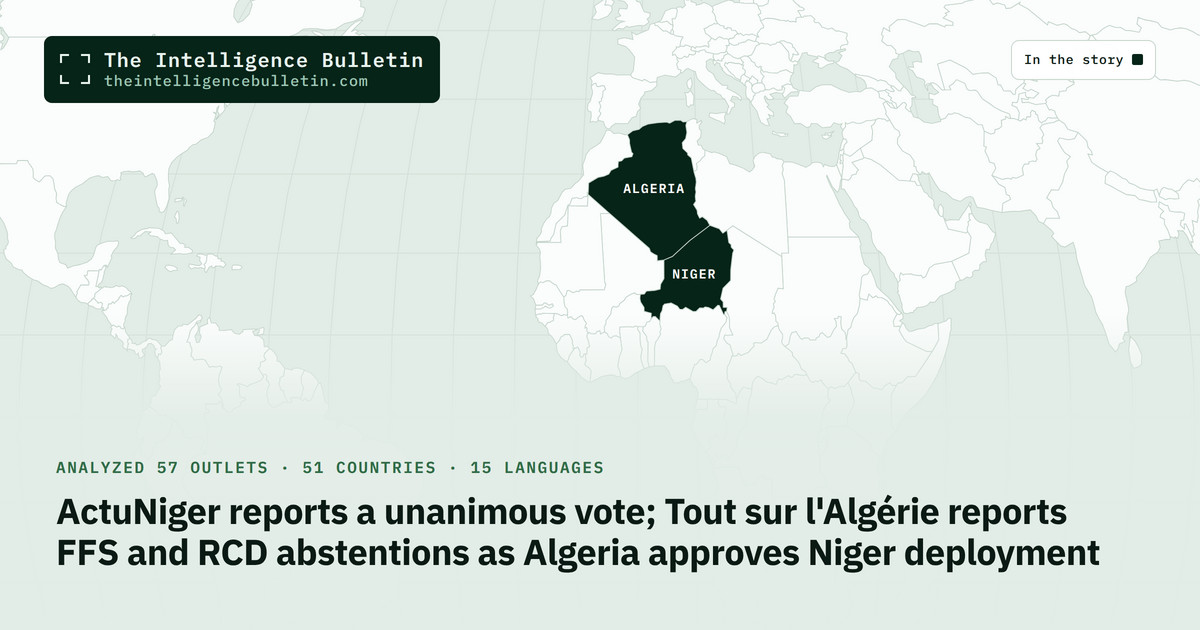
Algeria’s parliament approved sending army units to Niger on October 25, the country’s first foreign deployment since 1973, to protect oil installations and the Kafra field. ActuNiger and h24info report unanimous votes; Tout sur l’Algérie reports FFS and RCD abstained.
Across the press: ActuNiger and h24info’s AFP copy report a unanimous vote, while Tout sur l’Algérie records FFS and RCD deputies abstaining in the lower house.
Source base: 5 outlets read in full (Niger, Algeria, Burkina Faso, Morocco, Libya), selected from 57 analyzed.
- DisputedBoth chambers approved the deployment unanimously.Source: ActuNiger and h24info report a unanimous vote; TSA reports that FFS and RCD deputies abstained in the lower house.
- 5 of 5 · reported separatelyAlgeria’s two parliamentary chambers approved sending units of the Armée Nationale Populaire to Niger.Reported by all five sources on the basis of Algerian parliamentary and official statements.
- 3 of 5 · reported separatelyThis is Algeria’s first foreign military deployment since its forces were sent to the Middle East during the October 1973 war.ActuNiger, Burkina24 and the AFP-derived h24info account all state the 1973 benchmark.
- 4 of 5 · reported separatelyThe deployment’s stated purpose is to protect Algerian energy interests, including oil installations linked to Sonatrach, with the FLN naming the Kafra oil field 85 km from the Algerian border.Burkina24 cites Algerian authorities; h24info carries the lower house’s formula and AFP-quoted analysts; Akhbar Libya 24 cites reports; TSA carries the FLN’s Kafra claim.
- 4 of 5 · reported separatelyAlgeria had already sent Sukhoi Su-30 fighter jets to Niger in late August 2026 after what Algiers called a destabilization attempt and Niger called an orchestrated coup attempt.ActuNiger and Burkina24 report the deployments; h24info and Akhbar Libya 24 report the same late-August air support.
- In the coming weeksAlgeria’s announcement of troop numbers and a deployment timeline will show whether this is a substantial ground commitment or a symbolic presence alongside the jets already in Niger.
Full analysis
What happened Why it matters How each country tells it Where accounts conflict Room for disagreement Our assessment Sources and evidence
What happened
Convened by presidential decree in an emergency session, Algeria’s two parliamentary chambers met on October 25, 2026, and approved sending units of the Armée Nationale Populaire to Niger — the first use of paragraph 2 of Article 91 of the 2020 constitution, which lets the president order troops abroad once each chamber votes by a two-thirds majority. The Senate’s approval was reported as unanimous, with the AFP-derived account carried by Morocco’s h24info giving 148 votes in favor. In the lower house, the National People’s Assembly, ActuNiger and h24info report unanimity, while Tout sur l’Algérie records FFS and RCD abstentions.
The stated purpose is protecting Algerian energy interests. Burkina24 cites Algerian authorities saying the mission will secure oil installations tied to the state firm Sonatrach, and Tout sur l’Algérie reports the FLN, the parliamentary majority party, naming the Kafra oil field in Niger, 85 kilometers from the Algerian border. Analysts quoted by AFP in the h24info piece — political scientist Abdellah Akir and North Africa risk specialist Geoff Porter — add the trans-Saharan gas pipeline, planned to carry Nigerian gas to Europe through Niger and Algeria. Troop numbers, the operational calendar and the terms of the underlying military accord have not been announced, Burkina24 and Libya’s Akhbar Libya 24 both note.
The vote marks Algeria’s first foreign deployment since its forces went to the Middle East during the October 1973 war, a benchmark ActuNiger, Burkina24 and h24info all state; Burkina24 specifies those troops went in support of Egypt. The decision breaks with a defense doctrine long defined by non-intervention abroad, and extends a pattern of support to Niger’s junta since the two reconciled after Algeria’s destruction of a drone from Mali triggered a regional crisis. In early August, Algeria delivered four military helicopters. After special-forces soldiers mutinied in Niamey on the night of August 28–29 — which Algiers called a destabilization attempt and Niger blamed on France — Algeria flew in two patrols of Sukhoi Su-30 fighters, four aircraft, plus a refueling plane. On October 20 in Algiers, Niger’s Defense Minister General Salifou Mody signed a military cooperation protocol with Algeria’s chief of staff, General Saïd Chanegriha, after meeting Tebboune; Chanegriha pledged the army’s readiness to examine any Nigerien proposal. In an early-October televised interview, Tebboune said «Nous protégerons le Niger quoi qu’il arrive», adding that unnamed countries had conspired against it.
Niger’s junta, which under General Abdourahamane Tiani made the expulsion of French, American and European troops the emblem of its sovereignty after the coup that removed Mohamed Bazoum, has not officially commented on hosting Algerian soldiers across a nearly 1,000-kilometer border; ActuNiger notes the silence.
Why it matters
A half-century doctrine ends here. Since October 1973 Algeria has kept its army at home, its security policy resting, in Porter’s phrase to AFP, on dialogue, international law and multilateral forums. The vote replaces that with «une présence physique concrète» — a pivot Akir describes to AFP as also «un signal fort aux acteurs concurrents dont le Maroc et les Émirats arabes unis». The energy stakes are concrete: the Kafra field sits close enough to the border to be read as an extension of Algeria’s own perimeter, and the pipeline would lock Nigerian gas into Algeria’s European export route.
Each outlet frames the stakes from where it sits. ActuNiger, the only Nigerien voice, leads on attribution — the troops come at Niamey’s request — and stresses that the junta has not spoken publicly, preserving its sovereignty narrative. Tout sur l’Algérie foregrounds the domestic reaction: the FLN, RND, El Bina and Jil Jadid support the mission, but Jil Jadid warns that protecting economic interests «ne doit pas conduire à un engagement militaire sans limites». Burkina24, a Burkinabè outlet aligned with the Alliance of Sahel States, treats the vote as uncomplicated regional and energy solidarity. The AFP copy under Morocco’s h24info masthead reads it as a pivot from dialogue to force. Libya’s Akhbar Libya 24 reduces it to oil security, built on unnamed media reports.
For the junta the deployment is double-edged: it shores up a regime that survived an August mutiny, but hosting a foreign army sits awkwardly beside the expulsion of foreign forces that defined its claim to legitimacy.
How each country tells it
- ActuNiger · Niger · original reportingThe only Nigerien voice leads on attribution: it presents the deployment as made ‘at Niamey’s request’, a sovereign invitation rather than an Algerian initiative.
- Tout sur l’Algérie (TSA) · Algeria · original reportingThe independent Algerian newsroom leads on the split inside Algiers, with FLN and RND supporting, Jil Jadid both supporting and warning against unlimited entanglement, and FFS and RCD abstaining.
- Burkina24 · Burkina Faso · original reportingA junta-aligned Sahel neighbor reads the vote as a rupture with Algeria’s non-intervention doctrine and as reinforcement of the security alliance with Niger and its energy stakes.
- h24info.ma · Morocco · wire copyUnder a Moroccan masthead, this AFP-derived report reads the vote as Algeria’s pivot from dialogue to ‘tangible’ military presence, with analysts calling it a signal to Morocco and the UAE and a move to secure the trans-Saharan gas pipeline.
- Akhbar Libya 24 · LibyaAkhbar Libya 24 frames the deployment narrowly as an Algerian decision to send troops to secure oil installations in Niger.
Where accounts conflict
The central conflict is the lower-house vote. ActuNiger reports both chambers approved «à l’unanimité», and the AFP-derived h24info account has the Assembly voting «à l’unanimité» and the Senate unanimous with 148 votes. Burkina24 reports the Senate’s unanimous adoption but stops short of claiming unanimity in the Assembly. Tout sur l’Algérie reports that FFS and RCD deputies abstained. The FFS, Algeria’s oldest opposition party, said it supported the decision «dans le fond» but abstained «pour protester contre les circonstances de la convocation», declaring that parliamentarians «ne sont pas des exécuteurs d’instructions ou de simples vitrines institutionnelles». The RCD abstained on the grounds that a foreign engagement «peut entraîner des conséquences durables sur la sécurité de l’Algérie, exposer nos soldats à des risques majeurs et affecter nos relations avec les pays de la région», and that the decision should have followed consultation and serious deliberation. The unanimity framing presents as consensus what the Algerian record shows was a contested vote, erasing the only visible domestic opposition to Algeria’s first foreign deployment since 1973.
A smaller discrepancy rides along: ActuNiger places the session on Friday, October 25, while TSA, Burkina24, h24info and Akhbar Libya 24 all call it Sunday — and October 25, 2026 falls on a Sunday.
Room for disagreement
The strongest case that this will not go as planned, or should not have been done as it was, sits on the record with the RCD: «L’engagement de forces militaires à l’étranger peut entraîner des conséquences durables sur la sécurité de l’Algérie, exposer nos soldats à des risques majeurs et affecter nos relations avec les pays de la région.» The FFS adds the procedural charge that parliament was summoned to ratify, not deliberate. The operational facts are thin everywhere: no troop numbers, no timetable, no published mandate, a point Burkina24 and Akhbar Libya 24 both make. Most consequentially, Niamey has said nothing publicly. ActuNiger’s own framing shows why the silence matters: the regime that defined itself by expelling foreign troops now hosts them, and until its officials speak the deployment remains an Algerian decision awaiting a Nigerien imprimatur. If that comes late, qualified or not at all, the ground deployment could stall while the jets and helicopters already in-country stand in.
Our assessment
It is very likely that Algerian ground units deploy to Niger. The approval rests on convergence across independent reporting chains — the Nigerien ActuNiger, Algeria’s Tout sur l’Algérie, Burkina Faso’s Burkina24 and the AFP wire under Morocco’s h24info — with Libya’s Akhbar Libya 24 relaying the 1973 benchmark. The pattern behind the vote is already executed, not prospective: helicopters delivered, fighter jets flown in, a protocol signed, and a president who said on state television that Algeria will protect Niger «quoi qu’il arrive». Both governments have an interest in the reader seeing this as unanimous and consensual — Algiers legitimizing its first foreign deployment in five decades, Niamey preserving its sovereignty claim — which is precisely what the unanimity framing in ActuNiger and h24info delivers. The abstentions are a procedural counterweight, not a block on the mission.
What would change this: a public statement from Niamey qualifying or refusing the deployment, or weeks passing with no announcement of troop numbers and a timetable.
Sources and evidence
Press quoted
- How large a force is Algeria sending, where in Niger will it be stationed, and on what timetable?
- Has the CNSP government in Niamey publicly requested or formally accepted the deployment, or is ‘at Niger’s request’ only Algiers’ characterization?
- Will the mission be confined to guarding Sonatrach and Kafra energy infrastructure, or does the October 20 military protocol commit Algeria to broader counter-insurgency or regime-defense support?
That’s how the world told the story.
Get our daily open-source intelligence on world events in your inbox — one email a day, up to six stories.
Subscribe freeNo spam. One-click unsubscribe. See the latest email →