 AI-generated analysis published under the editorial responsibility of Rohit Sinnas. How it works →
See the 49 countries
Argentina, Australia, Austria, Bangladesh, Brazil, Brunei, Burundi, Canada, China, Colombia, Denmark, Ecuador, Egypt, France, Ghana, Indonesia, Ireland, Italy, Jordan, Kenya, Lebanon, Luxembourg, Malawi, Malaysia, Mexico, Netherlands, Nigeria, Pakistan, Philippines, Poland, Qatar, Romania, Russia, Serbia, Singapore, South Korea, Spain, Sweden, Switzerland, Syria, Trinidad and Tobago, Turkey, Uganda, Ukraine, United Arab Emirates, United Kingdom, United States, Venezuela, Vietnam
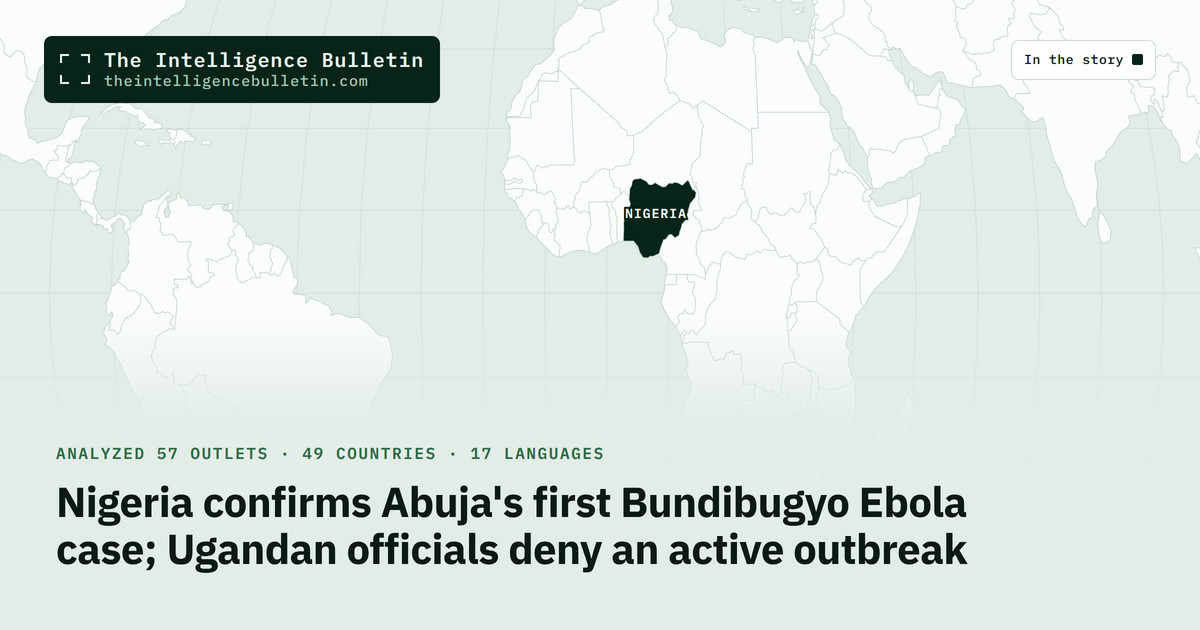
Nigeria confirmed its first imported Ebola case in Abuja on October 20: a woman who flew from Uganda, with 44 contacts now monitored. Ugandan officials say there is no active outbreak and she fell ill after arriving; the infection source is unresolved.
Across the press: Nigeria’s Premium Times leads with its own contact-tracing response, while Kenya’s Standard opens on Uganda’s denial and Italy’s Notizie headline on a nine-day missed diagnosis.
Source base: 5 outlets quoted (Nigeria, Uganda, Kenya, Ghana, Italy), selected from 57 analyzed. 4 read in full, 1 by its headline only.
- Denied on the recordUgandan health officials say Uganda has no active Ebola cases and the patient developed symptoms after arriving in Nigeria.Source: The Standard quotes Uganda’s Director General of Health Services Charles Olaro; ugandaonline.net quotes government spokesperson Alan Kasujja.
- 1 of 5 · The Standard onlyLaboratory tests detected the Bundibugyo strain of Ebola in the woman.The Standard reports the strain was detected in laboratory tests.
- 4 of 5 · reported separatelyNigeria has confirmed an Ebola case in Abuja, announced on Tuesday, October 20.Premium Times quotes the federal health ministry statement signed by Muhammad Pate; The Standard, Graphic Online and ugandaonline.net carry the confirmation.
- 3 of 5 · reported separatelyThe patient is a woman who recently arrived on an international flight from Uganda.Premium Times reports it from the federal government statement; Graphic Online and ugandaonline.net report the Uganda travel link.
- 3 of 5 · reported separatelyNigerian authorities have identified 44 close contacts.Premium Times quotes the federal health statement; The Standard and Graphic Online carry the same figure.
Full analysis
What happened Why it matters How each country tells it Where accounts conflict Room for disagreement Our assessment Sources and evidence
What happened
Nigeria’s federal health ministry confirmed a case of Ebola virus disease in Abuja on Tuesday, October 20, 2026. The patient — a woman who had recently arrived on an international flight from Uganda — was in isolation and receiving care at a private hospital, according to a statement signed by Coordinating Minister of Health and Social Welfare Muhammad Pate and carried by Premium Times. Contact tracing had already identified 44 close contacts, including healthcare workers, patients, caregivers and travel contacts. The Standard, Graphic Online and ugandaonline.net all carry the confirmation and the same contact count.
Laboratory tests detected the Bundibugyo strain of Ebola in the woman, The Standard reported. That species is rare and has no approved vaccine or treatment, though trials are under way, Graphic Online noted. The Ugandan government immediately rejected any link to an active outbreak at home. Uganda’s Director General of Health Services, Charles Olaro, said the country has "no confirmed active Ebola cases" and that the patient developed symptoms after arriving in Nigeria, The Standard reported. ugandaonline.net, relaying the Daily Monitor, quoted government spokesperson Alan Kasujja as saying simply, "There’s no Ebola in Uganda." The Standard added that, according to the World Health Organization, the patient’s symptoms began on October 7, four days after she arrived in Nigeria.
That timeline does not settle where she was infected. Ebola’s incubation period runs from two to 21 days, so symptom onset four days after arrival is consistent with exposure in either country or in transit. Nigeria has not publicly stated where it believes the woman contracted the virus. The only outlet to foreground a different problem is Italy’s Notizie Geopolitiche, whose full article could not be retrieved; its headline alone reports that the patient spent nine days in a hospital without being diagnosed. No other source in the set carries that detail, so it remains unconfirmed.
The case arrives amid a Bundibugyo outbreak in the Democratic Republic of the Congo that Premium Times, citing WHO, says had recorded more than 8,700 confirmed cases and 4,200 deaths as of October 6, with transmission continuing across dozens of health zones. Graphic Online, citing the European Centre for Disease Prevention and Control, put the toll higher: at least 9,500 cases and 4,600 deaths. Kenya reported its first imported case on October 6 and a ninth on October 20, a close family member of the first patient, according to Premium Times. Uganda itself recorded 20 cases between May and June 2026 and declared its outbreak over after completing the required 42 days without a new case.
Nigerian authorities had raised preparedness weeks earlier. The Nigeria Centre for Disease Control and Prevention issued a September 22 advisory that travelers from countries with active or relevant Ebola transmission could be required to complete a Health Declaration Form. Premium Times noted it is not yet clear whether that form or other entry-point surveillance helped identify the Abuja patient.
Why it matters
For Nigeria, the case is a test of a system that has passed before. In 2014, after an infected traveler arrived in Lagos from Liberia, Nigeria detected 19 confirmed and one probable case, with eight deaths, and was declared free of Ebola transmission on October 20, 2014 — exactly twelve years before this confirmation. The federal government’s statement, quoted by Premium Times, says: "Nigeria successfully contained Ebola in 2014, and we have the experience and public health systems to respond to this case." For Africa’s largest economy and most populous city, a rare Ebola strain with no approved vaccine raises the stakes beyond that familiar pattern.
For the region, the case is not just one patient. Graphic Online frames it as the first West African state to report a case linked to the current East African crisis, and notes that the United States advised its citizens on Monday to reconsider travel to Kenya because of health risks. The Bundibugyo species’s lack of a vaccine means containment depends entirely on rapid identification, isolation and contact tracing — exactly what a nine-day diagnostic delay, if confirmed, would compromise.
For Uganda, the denial is legally and economically important. Its declaration that the outbreak ended after 42 days without a new case underpins a return to normal trade and travel. If the Abuja patient acquired the virus in Uganda, that declaration would be called into question. If she acquired it in Nigeria, the failure would be Nigeria’s own surveillance. Neither government has presented evidence that closes the question.
How each country tells it
- Premium Times · Nigeria · original reportingLeads with Nigeria’s domestic response—isolation, 44 contacts, a minister’s call for vigilance—and the country’s 2014 containment record.
- ugandaonline.net · Uganda · carries Daily MonitorPresents the case as concerning but immediately relays the Ugandan government’s denial that any Ebola outbreak exists.
- The Standard · Kenya · original reportingOpens with Uganda’s denial and adds the WHO timeline that the patient fell ill on October 7, four days after arriving in Nigeria.
- Graphic Online · Ghana · original reportingTreats the case as a West African regional threat, linking it to the DRC Bundibugyo outbreak, Uganda’s earlier outbreak and Kenya’s nine cases.
- Notizie Geopolitiche · Italy · original reportingIts headline leads with the patient having spent nine days in hospital without diagnosis, a health-system failure angle absent from the other sources.
Where accounts conflict
The central dispute is origin. Uganda’s health ministry says it has no active Ebola cases and that the patient fell ill after arriving in Nigeria; The Standard carries Olaro’s statement and the WHO symptom-onset date of October 7, four days after arrival. Nigerian officials have not publicly contradicted that claim, but they also have not said where they think the infection occurred. Premium Times, which published the federal statement in full, makes no mention of where the woman might have been infected. That silence leaves two possibilities: the virus was already incubating when she boarded the flight from Uganda, or she was infected in Nigeria or en route. No source reports any test result or epidemiological finding that resolves it.
A second, smaller discrepancy concerns the scale of the DRC outbreak. Premium Times, citing WHO as of October 6, reports more than 8,700 cases and 4,200 deaths. Graphic Online, citing the European Centre for Disease Prevention and Control, reports at least 9,500 cases and 4,600 deaths. The differences are likely a matter of dates and data sources, but they illustrate that even the background numbers are moving quickly.
The most consequential unconfirmed claim is the diagnostic delay. Notizie Geopolitiche’s headline — the only part of that Italian outlet’s article that could be read — says the patient remained nine days in a hospital without a diagnosis. If that is accurate, it means the first nine days of her illness occurred inside a healthcare setting before Ebola was suspected, though the standard infection-control precautions Nigeria says it has urged would need to have been in place. The federal statement’s emphasis on immediate isolation and contact tracing does not address that timeline.
Room for disagreement
The strongest case that this story will not escalate is built on facts that are not in dispute. The patient is isolated. Forty-four contacts have been identified and are being monitored. Nigeria’s 2014 response, which WHO praised for rapid case detection and extensive contact tracing, produced only eight deaths. The federal government says investigations are ongoing and it will provide accurate and timely information. If the Bundibugyo virus was imported from a country with no active outbreak, then the chain of transmission may already be closed. Uganda’s assertion of no active cases, if true, means there is no continuous source feeding new importations. The nine-day delay, even if it occurred, may not have produced secondary cases: Ebola transmits through direct contact with bodily fluids, and a hospitalized patient under basic infection control would have had limited opportunities to spread the virus before diagnosis. No secondary case has been reported from Abuja or anywhere else.
Our assessment
It is likely that this imported case will be contained without onward local transmission, but the next three weeks are the test. The reasoning is that four outlets — Nigeria’s Premium Times, Kenya’s The Standard, Ghana’s Graphic Online and Uganda’s ugandaonline.net — all confirm the same immediate response facts: a single patient in isolation, 44 contacts identified, public health teams deployed. Nigeria’s record in 2014 and the NCDC’s raised preparedness support the view that the country can repeat it. The main unresolved variable is the delay reported only in an Italian headline, and the unresolved origin. Uganda has a clear interest in denying that the infection began on its soil, and Nigeria has a clear interest in presenting the response as fast; neither has produced the laboratory or epidemiological evidence that would settle the question.
What would change this: confirmation of any secondary case among the 44 contacts, or evidence that the patient was infected in Uganda after its declared end, would shift the assessment toward a regional emergency response.
Sources and evidence
Press quoted
- Where and when did the woman acquire Ebola, given Uganda says it has no active cases and the WHO timeline shows symptoms after arrival in Nigeria?
- Do any of the 44 identified contacts develop symptoms during monitoring?
- Why did the patient remain nine days in hospital without a diagnosis, and was transmission possible during that window?
That’s how the world told the story.
Get our daily open-source intelligence on world events in your inbox — one email a day, up to six stories.
Subscribe freeNo spam. One-click unsubscribe. See the latest email →