 AI-generated analysis published under the editorial responsibility of Rohit Sinnas. How it works →
See the 50 countries
Albania, Argentina, Armenia, Austria, Azerbaijan, Bosnia and Herzegovina, Brunei, Bulgaria, Canada, China, Croatia, Cuba, Cyprus, Czech Republic, Egypt, Finland, France, Greece, Hungary, India, Indonesia, Israel, Italy, Jamaica, Kenya, Latvia, Lebanon, Lithuania, Macedonia, Moldova, Montenegro, Netherlands, New Zealand, Oman, Poland, Portugal, Romania, Russia, Saudi Arabia, Slovakia, Spain, Switzerland, Taiwan, Turkey, Tuvalu, Ukraine, United Arab Emirates, United Kingdom, United States, Zimbabwe
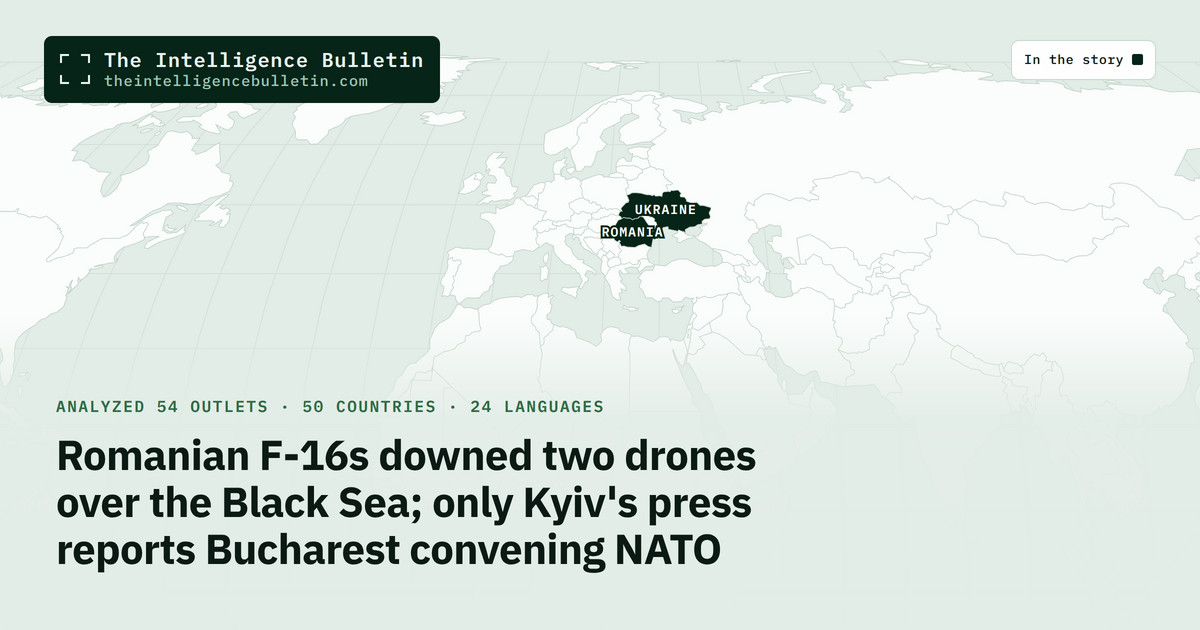
Romania’s defense ministry says two F-16s shot down two drones over the Black Sea near Sulina on Saturday, after a week of incursions, without naming their origin. Kyiv’s Dialog.UA reports Bucharest is convening a NATO council Tuesday; Moscow’s Ura.ru stresses the origin is unstated.
Across the press: Romania’s ministry left the drones’ origin unnamed; only Kyiv’s Dialog.UA reports Bucharest convening a NATO council Tuesday.
Source base: 5 outlets quoted (Romania, Russia, Ukraine, Turkey, China), selected from 54 analyzed. 4 read in full, 1 by its headline only.
- 1 of 5 · dialog.ua onlyBucharest, at its own initiative and after informing NATO and EU partners, is convening a North Atlantic Council meeting on Tuesday devoted to Black Sea defense and deterrence.Romania’s foreign ministry, as reported by dialog.ua.
- 4 of 5 · reported separatelyTwo drones that entered Romanian airspace over the Black Sea were shot down by two Romanian Air Force F-16s on the evening of October 17.Romania’s Ministry of National Defence, cited by Cotidianul, Ura.ru, dialog.ua and Xinhua.
- 4 of 5 · reported separatelyThe F-16s took off from Borcea at 17:43 after radar detected a group of targets about 120 km east of Snake Island; the first drone was downed at 18:01 and the second at 18:05.Romanian defense ministry timeline, carried identical to the minute by all four readable outlets.
- 2 of 5 · reported separatelyThe ministry identified both targets only as drones and did not specify their origin.Ura.ru states the omission explicitly; Xinhua quotes the ministry’s drone identification, while Cotidianul and dialog.ua likewise name no origin.
- 2 of 5 · reported separatelyThe shootdowns follow a week of repeated drone incursions near Romania’s border, including October 14-15 incidents and an overnight Tulcea county alert.Cotidianul, from defense ministry reports; dialog.ua separately notes seven drone attacks on ships near Romania and Bulgaria over two weeks.
- Tuesday, 20 October 2026The North Atlantic Council meets at Romania’s request on Black Sea defense; any statement would be the first collective word on the drones.
- Next daysAfter a week of near-nightly incursions and Tulcea alerts, another drone crossing would test whether the shootdown changes the pattern or the response.
- Still openWhat is the origin of the drones that struck the ships? · Were the attacks carried out by Russian or Ukrainian forces?
Full analysis
What happened Why it matters How each country tells it Where accounts conflict Room for disagreement Our assessment Sources and evidence
What happened
On Saturday, October 17, 2026, two Romanian Air Force F-16s took off from the 86th Air Base at Borcea and shot down two drones over Romanian territorial waters in the Black Sea near Sulina. The operational timeline is not in dispute. Four accounts in four countries — Romania’s Cotidianul, Russia’s Ura.ru, Ukraine’s Dialog.ua and China’s Xinhua — all carry the same Ministry of National Defence statement to the minute. A fifth, Turkey’s Haber7, ran a headline about a NATO airspace violation and an emergency-code scramble; its article text could not be retrieved.
At 17:43 local time, radar detected a group of aerial targets about 120 kilometers east of Snake Island moving southwest. The two F-16s, on Air Policing duty, were already being sent up from Borcea. The first target entered Romanian airspace at 17:59 and was shot down two minutes later, 25 kilometers southeast of Sulina. The second crossed the border at 18:01 and was destroyed at 18:05, 20 kilometers east of the town. Both interceptions happened above Romania’s territorial waters. Defense Minister Radu Miruță congratulated the crews on Facebook: “Congratulations, colleagues! Nothing we have worked for until now has been in vain.”
The ministry identified the targets only as drones and did not say where they came from. Ura.ru made that omission the point of its report, writing that “the military department did not specify their origin.” Xinhua quoted the ministry’s line that both aerial targets were “identified as drones,” with further information to be provided after the mission ended. Cotidianul likewise named no origin. Kyiv’s Dialog.ua never calls these particular drones Russian either. It places the shootdown beside “Russian hybrid attacks on Europe,” notes that seven ships have been attacked by drones near Romania and Bulgaria over the previous two weeks, and recalls President Zelensky blaming Russia for the October 6 strike on two merchant ships off Bulgaria. But the attribution is achieved by adjacency, not by an explicit claim about the two drones downed on Saturday.
The wider week makes the shootdown less sudden. Cotidianul reports that overnight Friday to Saturday, Romanian radar detected a target approaching from Ukraine; two Spanish F-18s took off from Mihail Kogălniceanu to monitor it, and a RO-Alert message went out to northern Tulcea county at 1:54 a.m. before being lifted at 2:30 a.m. with no airspace violation. On October 15, a drone appeared southeast of Sulina, stayed over Romanian territorial waters for about a minute, and disappeared from radar. On October 14, one drone entered briefly near Sulina and returned to Ukraine, where Ukrainian air defense shot it down; later that same evening, two more aerial targets entered Romanian airspace around 8:04 p.m., with radar contact on one lost over the sea and the other destroyed near Reni inside Ukraine.
On the alliance response, the record splits. Dialog.ua alone reports, citing Romania’s foreign ministry, that Bucharest informed NATO allies and European Union partners and, at Romania’s initiative, is convening a North Atlantic Council meeting on Tuesday devoted to Black Sea defense and deterrence. The other three readable outlets stop at the defense-ministry release and do not mention any NATO meeting. A reader of Cotidianul gets a sovereign air-defense success; a reader of Dialog.ua gets a NATO ally pulling the alliance toward the Black Sea.
Why it matters
Saturday’s engagement is the first in the sequence Cotidianul documents in which Romanian aircraft ended a drone flight with weapons. The earlier intruders retreated into Ukraine, vanished from radar, or were destroyed by Ukrainian air defense. Now Romania has crossed from tracking and warning to spending missiles over its own waters. A NATO member’s jets are in kinetic contact with unidentified aircraft during a war on its border, and the official account gives no confirmed adversary — only an airspace violation.
The cost question follows immediately. Beneath Cotidianul’s report, readers asked whether the AIM-9 Sidewinders will run out “like the Patriots sent to Ukraine” and whether an air-defense solution of expensive missiles against cheap drones is sustainable. The intercepts are therefore not only a military event but a defense-budget event in Bucharest, at a time when repeated near-nightly incursions could multiply the expenditure.
If the Dialog.ua account of a Tuesday North Atlantic Council session is accurate, the political stakes rise beyond Romania. An airspace violation handled nationally is a policing matter; a convened NATO council makes it a collective signal to Moscow and the Black Sea littoral. But the most consequential institutional step in the story comes from one outlet. No direct NATO or European Union statement appears anywhere in the source set; the only alliance claim is Romania’s own foreign ministry as reported by Kyiv.
How each country tells it
- Cotidianul · Romania · original reportingNational air-defense success: Romanian F-16 pilots shot down two drones in sovereign airspace, with the defense minister congratulating crews and a week of prior incursions logged.
- Ura.ru · Russia · original reportingA neutral relay of the shootdown that foregrounds the defense ministry not specifying the drones’ origin.
- dialog.ua · Ukraine · original reportingThe NATO escalation account: Bucharest informed allies and is convening a North Atlantic Council meeting Tuesday on Black Sea deterrence, set against Russian hybrid attacks.
- Haber7 · TurkeyNATO airspace violation and an emergency-code F-16 scramble, with the drones going down in the Black Sea.
- Xinhua News Agency · China · original reportingA stripped state-agency account of Romania defending ‘its Black Sea territorial waters,’ quoting only the defense ministry: no origin, no NATO.
Where accounts conflict
The accounts split not on what happened in the air but on whether it is being made an alliance matter. Dialog.ua’s foreign-ministry account says Bucharest informed NATO and EU partners and is convening the North Atlantic Council on Tuesday; Cotidianul, Ura.ru and Xinhua carry the defense ministry’s operational statement and report no such meeting. That is an absence rather than a denial, but it determines whether the reader sees a national air-defense action or a NATO threshold. Haber7’s headline falls on the escalated side, while on a narrower point it calls the takeoff an emergency-code scramble, where the four ministry-derived accounts describe a standard Air Policing launch. With the Turkish article text unavailable, only the headline can be tested.
Room for disagreement
The strongest case that October 17 will prove to be an isolated air-defense action rather than a new threshold is the deliberate narrowness of the official record. Romania’s ministry did not name the drones’ origin and said further information would come only after the mission concluded. Ura.ru made that silence the explicit point of its report. The most escalatory element — the convened North Atlantic Council — rests on a single Kyiv outlet’s account of a Romanian foreign ministry statement. A reader of Bucharest’s own press sees a successful Air Policing mission, with the defense minister congratulating crews and commenters debating missile costs, not an Article 5 moment. If the drones turn out to have been Ukrainian, stray, or unidentifiable, and if Tuesday’s meeting produces only consultation, the shootdown will sit in the record as Romania enforcing its rules of engagement on an isolated evening.
Our assessment
It is likely that the October 17 shootdown marks the start of a repeated Romanian interception campaign rather than a one-off finale. The pattern is strongly corroborated: Cotidianul’s defense-ministry logs show incursions on October 14, twice that evening, October 15, and an overnight Tulcea alert into Saturday, while Dialog.ua separately counts seven drone attacks on ships near Romania and Bulgaria in two weeks. That is a sustained campaign, and Saturday is what happens when such a campaign keeps crossing a sovereign border. Bucharest has now shown both the operational response and the political frame: fire on unidentified intruders, keep the public attribution narrow, and take the matter to NATO for consultation if Dialog.ua’s report is accurate. That points to more interceptions if the drones keep coming, not fewer.
The NATO response itself will probably remain consultative. A North Atlantic Council meeting on Tuesday, if it occurs, is a political signal, not an automatic change to collective-defense rules, and without an identified origin the alliance has room to condemn incursions without assigning responsibility. Kyiv has an interest in readers seeing the war reaching a NATO ally; Moscow has an interest in the official silence on origin; Bucharest has an interest in looking both sovereign and supported.
What would change this: a Romanian or NATO statement after Tuesday that names the drones’ origin would move the story from ambiguous air-defense to explicit alliance confrontation.
Sources and evidence
Press quoted
- Whose drones were they, and will Romania or its allies publicly attribute an origin?
- What will the North Atlantic Council say on Tuesday, and will it mark any shift in NATO’s Black Sea posture?
- Which missiles did the F-16s fire, and is this interception rate sustainable against Romania’s own stocks?
That’s how the world told the story.
Get our daily open-source intelligence on world events in your inbox — one email a day, up to six stories.
Subscribe freeNo spam. One-click unsubscribe. See the latest email →