 AI-generated analysis published under the editorial responsibility of Rohit Sinnas. How it works →
See the 39 countries
Austria, Bangladesh, Bosnia and Herzegovina, Canada, China, Cyprus, Czech Republic, France, Germany, Hong Kong, Hungary, India, Indonesia, Iraq, Israel, Italy, Japan, Lithuania, Madagascar, Malaysia, Moldova, Myanmar, New Zealand, Oman, Pakistan, Philippines, Qatar, Romania, Russia, Serbia, South Korea, Sri Lanka, Switzerland, Taiwan, Thailand, Turkey, Ukraine, United Kingdom, United States
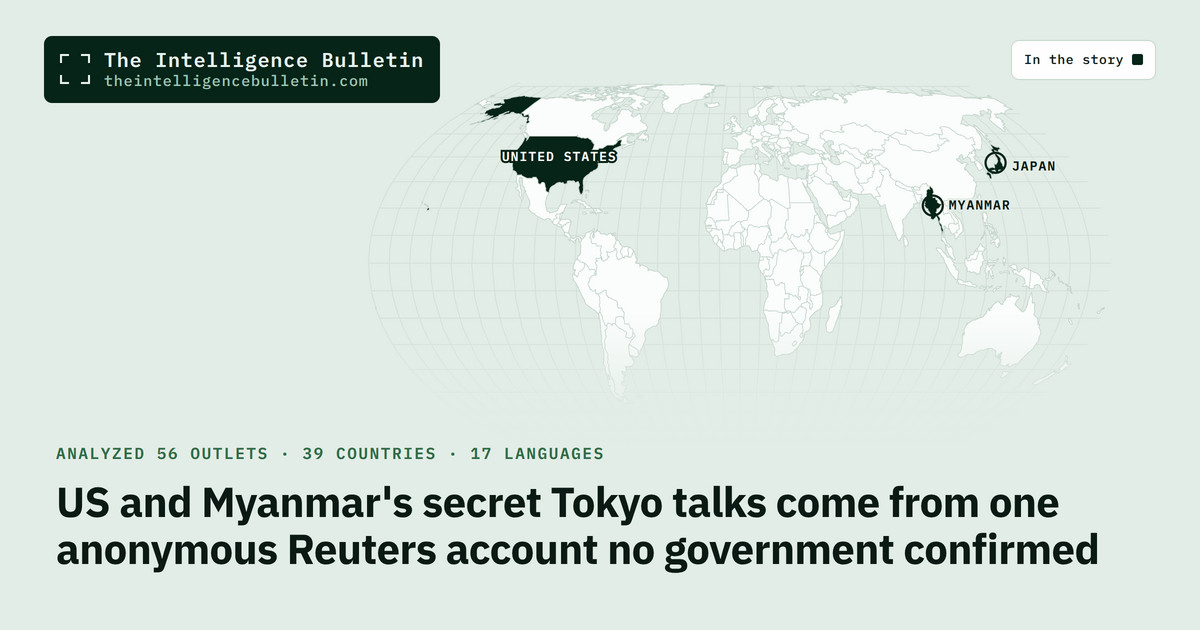
US and Myanmar’s military government held undisclosed talks in Tokyo last week, their second in a month, per Reuters sources — unconfirmed by either government on the record. Washington’s public line: ‘practical wins’ on scam centers; Min Aung Hlaing stays under genocide sanctions.
Across the press: Four outlets in four countries tell one story: Reuters’s anonymous sourcing, which only the wire itself softens with State Department ‘practical wins’ framing.
Source base: 4 outlets read in full (United Kingdom, India, Taiwan, Bosnia and Herzegovina), selected from 56 analyzed.
- 4 of 4 · one shared reportThe US and Myanmar’s military-backed government held talks in Tokyo last week, their second meeting in a month.Reuters, citing three anonymous people with knowledge of the engagement, including a US official.
- 4 of 4 · one shared reportMichael Vance, US assistant secretary of state for intelligence and research, led the Tokyo talks with more than a dozen US officials; Myanmar’s representative was unknown.Reuters, citing one of the anonymous sources.
- 4 of 4 · one shared reportMid-September talks in Naypyitaw between Vance and Min Aung Hlaing focused on releasing an American businessman and shutting scam centers targeting Americans, and could open rare-earth discussions.Reuters, drawing on its previous reporting.
- 3 of 4 · one shared reportThe US State Department says it engages with all groups in Myanmar and frames the outreach as pursuing ‘practical wins for the American people — particularly those impacted by transnational crime,’ while declining to comment on the latest talks.State Department spokesperson statements carried by Reuters; the fuller ‘practical wins’ wording appears in the Economic Times wire version.
- 4 of 4 · one shared reportJapan hosted the talks, and its foreign ministry said it had been ‘communicating as necessary’ with both sides while declining comment on specific exchanges.Japan Foreign Ministry emailed statement, reported by Reuters.
- Trigger: further Japan government movesWhether Tokyo follows envoy and lawmaker overtures with formal policy would show if Japan is host or partner in the re-engagement.
Full analysis
What happened Why it matters How each country tells it Where accounts conflict Room for disagreement Our assessment Sources and evidence
What happened
A single Reuters dispatch, built on three anonymous people with knowledge of the engagement, including one US official, is the entire factual basis for the story that ran under four mastheads. The report said the United States and Myanmar’s military-backed government held undisclosed talks in Tokyo last week, their second meeting in a month, following a mid-September session in Naypyitaw between Michael Vance, assistant secretary of state for intelligence and research, and Myanmar’s coup leader-turned-president, Min Aung Hlaing. Vance led the Tokyo talks with more than a dozen US officials, one of the sources said; Reuters could not establish who represented Myanmar. The three people requested anonymity because of the sensitivity of the meeting.
No government confirmed the Tokyo meeting. The State Department, in the fuller text of the wire published by The Economic Times, declined to comment on “the content and parameters of purported sensitive discussions,” but a spokesperson spoke on the record about Myanmar policy: the Bureau of East Asian and Pacific Affairs “is shaping, implementing and engaging on US policy toward the country,” while Vance’s Bureau of Intelligence and Research “does not lead on policy.” The same spokesperson said engagement “is rooted in the desire to achieve practical wins for the American people — particularly those impacted by transnational crime.” The Independent and Taipei Times carried only the shorter on-record line that the department “engages with all groups in Myanmar on issues affecting US interests” and said it did not respond to a request for comment on the latest talks. Myanmar’s military-backed government did not respond. Japan’s foreign ministry, asked about hosting, said it had been “communicating as necessary” with both sides but declined to comment on specific diplomatic exchanges.
The earlier Naypyitaw talks focused on securing an American businessman’s release and shutting down scam centers targeting Americans, and the dispatch said those talks “could pave the way” for broader discussions, including on Myanmar’s rare-earth deposits. Elsewhere the same text reports that US officials “have also discussed access” to the country’s heavy rare-earth deposits, used in electric vehicles and wind turbines. The officials acknowledge significant obstacles: the deposits are largely located in territory controlled by ethnic armed groups fighting the military, and China, the main buyer, could balk at any US role. A major focus of the US push is scam hubs that run romance and other frauds and have swindled Americans out of billions of dollars, the sources said. Researchers say many scam operations are based in areas controlled by army-backed militia and some proceeds flow to the military, raising doubts about whether Myanmar’s leaders are serious about enforcement; the military-backed government says it is participating in a multinational effort to curb scam centers.
The US last week lifted sanctions on the daughter of a Myanmar businessman accused of supporting the military, saying it was part of a new approach and “commits to re-examining the range of tools” Washington has used. Min Aung Hlaing remains under sanctions for the coup, the crackdown, and the 2016-2017 killings and expulsions of Rohingya Muslims that Washington declared a genocide. Whether Japan has any stake beyond host is unclear, including for earlier talks in Tokyo in June. Japan’s acting envoy met Myanmar’s foreign minister this month in their first known public engagement, though Tokyo does not formally recognize the administration, and a September visit by parliamentarian Hiromichi Watanabe was aimed at restarting cooperation and development aid. Around 300 Japanese companies still operate in Myanmar, down from more than 400 in 2020, according to JETRO.
Why it matters
This is not a story about a verified diplomatic pivot; it is a story about how far one anonymous wire was stretched. The Independent gave it the strongest frame: its headline says the US is “quietly re-engaging with Myanmar regime in major reversal of post-coup policy,” and its text says the talks mark Washington’s first direct engagement since the 2021 coup. It paired the dispatch with Hunter Marston of the Lowy Institute, who called rare earths “probably the chief strategic asset” Washington wants. That interpretive gloss is one the underlying record does not itself carry.
The Economic Times ran the same Reuters text under a defence heading, “US holds more secret talks with Myanmar’s military-backed rulers in Tokyo, sources say,” and its version carries the fullest official counterweight: the State Department’s clarification that Vance’s bureau does not lead policy and the “practical wins” language. A reader of that version could see the engagement as crime-focused rather than a policy reversal. Taipei Times compressed the dispatch to a neutral regional item, “US, Myanmar hold more talks: sources,” used the word “junta” throughout, dropped the Lowy commentary and Japanese company count, and placed it beside unrelated world briefs. Bosnia’s Klix.ba headlined the pariah angle — “Secret talks in Tokyo: Americans met with the military government of Myanmar they previously avoided” — and preserved the genocide and sanctions context while omitting the State Department’s fuller clarification. None of the four adds independent reporting beyond the single wire.
How each country tells it
- The Independent · United Kingdom · carries ReutersFrames the Tokyo meeting as a ‘major reversal of post-coup policy,’ foregrounding the policy shift and pairing the Reuters account with Lowy Institute commentary on rare earths as Washington’s real interest.
- The Economic Times · India · wire copyRuns the Reuters dispatch straight for India’s defence and business readership, headlining ‘secret talks’ with ‘military-backed rulers.’
- Taipei Times · Taiwan · wire copyCompact ‘US, Myanmar hold more talks: sources’ treatment that relays the Reuters text without the policy-reversal gloss.
- Klix.ba · Bosnia and Herzegovina · carries ReutersBosnian-language condensation centered on Washington meeting a military government it ‘had previously avoided,’ keeping the sanctions and genocide context prominent.
Where accounts conflict
There is no cross-outlet factual conflict here, because all four pieces are the same Reuters text. The real tension is internal. The anonymous sources say the meeting happened, but no government confirms it; Japan’s “communicating as necessary” declines to acknowledge any specific exchange, and the State Department’s on-record comments are about policy toward Myanmar, not the Tokyo talks. The word “secret” in three headlines rests entirely on the unnamed sources.
The dispatch also moves on rare earths: one passage says the September talks “could pave the way” for broader discussions on the minerals, while another says US officials “have also discussed access.” Those are different claims — a possible future agenda versus a present subject — and the single account contains both. Finally, the masthead a reader opened determined how much of the official counterweight they saw. The Economic Times carried the full State Department statement that Vance’s bureau “does not lead on policy”; The Independent and Taipei Times carried only the general engagement line.
Room for disagreement
The strongest case that this is a broad strategic opening rather than a narrow crime channel comes from Hunter Marston, quoted in the wire and the Independent. If he is right, rare earths are the real prize and scam centers are the entry point; the quick return to Tokyo in a month suggests momentum, and the sanctions lift on a businessman’s daughter is a tangible concession. Japan’s own re-engagement — the acting envoy’s meeting, Watanabe’s visit, the 300 companies still in country — could turn a host into a partner, and Myanmar’s government has every incentive to offer whatever access it can to regain standing. But that case rests on inference and anonymous sourcing, not on any stated agenda.
Our assessment
It is very likely that the Tokyo channel is a narrow, scam-focused re-engagement rather than the “major reversal” the Independent’s headline announces. The only on-record US language frames the outreach as pursuit of “practical wins for the American people — particularly those impacted by transnational crime,” and the bureau involved does not lead on policy. The rare-earth deposits cannot be handed over because they sit in territory controlled by armed groups fighting the junta, and China is the main buyer, so the strategic asset Marston describes is not one Naypyitaw controls. Japan declined to confirm any specific exchange, and neither Washington nor Naypyitaw confirmed the meeting on the record.
What would change this: an on-record statement from Washington or Tokyo acknowledging a rare-earth or broader political agenda, or formal Japanese recognition of the military-backed government, would move the call.
Sources and evidence
Press quoted
- Who represented Myanmar in Tokyo, and does the junta confirm the talks?
- What was actually discussed last week — did scam-center cooperation, rare earths, or the detained businessman advance?
- Does Japan have a stake beyond hosting, and will Tokyo’s own re-engagement deepen?
That’s how the world told the story.
Get our daily open-source intelligence on world events in your inbox — one email a day, up to six stories.
Subscribe freeNo spam. One-click unsubscribe. See the latest email →