 AI-generated analysis published under the editorial responsibility of Rohit Sinnas. How it works →
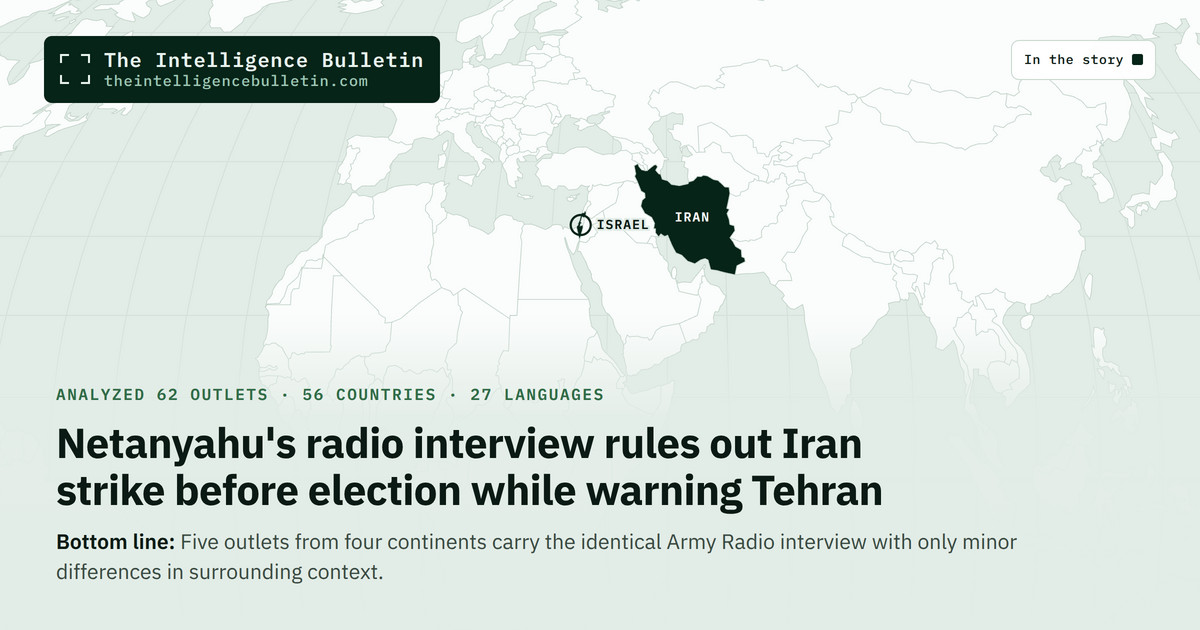
| Press analyzed | 62 outlets · 56 countries · 27 languages |
| Press quoted | 5 sources · 3 independent accounts |
See the 56 countries
Armenia, Australia, Austria, Azerbaijan, Belgium, Bosnia and Herzegovina, Bulgaria, Canada, Chile, China, Croatia, Cuba, Cyprus, Czech Republic, Egypt, Finland, Germany, Ghana, Greece, Hungary, Indonesia, Iran, Iraq, Ireland, Israel, Italy, Jordan, Kazakhstan, Kuwait, Lebanon, Lithuania, Luxembourg, Malaysia, Netherlands, New Zealand, Nigeria, Oman, Philippines, Poland, Portugal, Qatar, Romania, Russia, Senegal, Serbia, Singapore, South Korea, Sri Lanka, Switzerland, Syria, Taiwan, Tunisia, Turkey, Ukraine, United Arab Emirates, United Kingdom
Five outlets from four continents carry the identical Army Radio interview with only minor differences in surrounding context.
- Single sourceIran claims all-weather monitoring of the Strait of Hormuz after a cargo ship was attacked and sunk.Source: Wallstreetcn headline
- Independently reportedNetanyahu said he does not favor a preemptive strike on Iran before the Oct 27 election.Source: Free Malaysia Today, EconoTimes, Vetogate, Novini citing Israel Army Radio interview
- Independently reportedNetanyahu warned that even if Iran attacks, political rivals would blame him.Source: Free Malaysia Today, EconoTimes, Vetogate citing Netanyahu on Army Radio
- Independently reportedIsrael and Iran have not traded direct fire since June.Source: Free Malaysia Today, EconoTimes, Vetogate
- Will Netanyahu consider military action against Iran after the Oct 27 election?
- What specific recent discussions occurred between Netanyahu and Washington on Iran?
Press quoted
Full analysis
Netanyahu spoke on Israel Army Radio on October 14 and said he did not favor a preemptive strike on Iran before Israel’s October 27 election. He told the interviewer that such a move would not be convenient or good for Israel. He added that even if Iran fired missiles first, his political rivals would still blame him for any escalation. At the same time he repeated earlier warnings that Israel would respond forcefully to any attack from Tehran or its proxies.
The interview took place against a backdrop of direct conflict between the United States and Iran that began on February 28, when American and Israeli forces struck Iranian targets and Tehran replied with strikes on Israel and Gulf states. No direct exchanges of fire between Israel and Iran have occurred since June. Netanyahu declined to discuss whether a strike might become an option after the election or to detail recent talks with Washington on the subject.
He also warned that Iranian-backed groups could try to launch attacks on Israel in the days before voters go to the polls. Israeli Defense Minister Israel Katz, speaking from territory Israeli forces occupy in southern Lebanon, separately threatened Hezbollah with further losses of land around Nabatieh and the Litani River if the group attacked Israel. Katz said a million Shiite residents could be displaced and that Hezbollah positions in Beirut would not be spared. Israel began air strikes and a ground operation in southern Lebanon earlier in the year after Hezbollah fired into Israel in retaliation for the earlier strikes on Iran. Hundreds of thousands of Lebanese Shiites have already been uprooted by that fighting.
Three of the five outlets that carried the story reproduced nearly identical accounts of the radio interview. Free Malaysia Today, EconoTimes and Vetogate each quoted Netanyahu’s line that a preemptive strike was not convenient and not good, and each included his remark that rivals would blame him even if Iran struck first. All three noted the February 28 start of the wider US-Iran conflict, the absence of direct fire since June, and Netanyahu’s warning about proxy attacks before the election. They also recorded his refusal to elaborate on post-election options or on recent Washington consultations. Vetogate attributed part of its version to Reuters and added Katz’s comments on Hezbollah and the potential displacement of a million Shiites. Free Malaysia Today and EconoTimes both mentioned Saudi Arabia’s recent experience with Houthi strikes, including an attack on Riyadh airport that killed 13 people, and Netanyahu’s noncommittal reply when asked whether Israel was assisting Riyadh.
Novini published only a short headline and a single sentence that summarized the election timeline and Netanyahu’s rejection of a preemptive strike. It carried none of the surrounding context on Lebanon, the Houthis or the February conflict that appeared in the other three pieces.
Wallstreetcn’s headline alone connected the no-strike pledge to events in the Strait of Hormuz, stating that Iran claims all-weather monitoring of the waterway after a cargo ship was attacked and sunk. The piece itself was not available for full reading, but its published headline supplied the sole reference among the five outlets to that specific maritime incident.
The five accounts therefore rest on a single originating interview conducted on Israel Army Radio. The three most detailed versions match one another on every quoted line and on the basic timeline of the US-Iran confrontation. The only measurable differences appear in the additional regional material each outlet chose to include or to omit. No outlet contradicted Netanyahu’s stated position on a preemptive strike or his warning about political blame. The single-source claim about the Hormuz Strait incident stands apart from the interview and receives no corroboration in the other four pieces.
A reader who saw only the Bulgarian headline would learn the election date and the rejection of a preemptive strike but would miss the explicit warnings to Iran and Hezbollah, the background on the February conflict, and the scale of displacement already produced by fighting in Lebanon. A reader who saw only the Chinese headline would encounter an immediate link to Gulf shipping risks that does not appear elsewhere in the set. A reader limited to the Malaysian, American or Egyptian accounts would receive the fullest version of the radio interview plus varying amounts of context on Saudi Arabia and Lebanon, yet would still encounter no reporting from inside Iran or from Israeli domestic outlets that might frame the same statement differently.
The interview itself supplies the clearest warrant for the central claim. Netanyahu spoke on the record to Army Radio, and four separate outlets reproduced the same phrasing from that broadcast. The political timing supplies the most direct explanation for the rapid and consistent relay: the statement was issued two weeks before voters decide whether to keep Netanyahu in office. Outlets with regional audiences added details on Houthi attacks or Hezbollah threats because those conflicts already involve their readers’ governments or neighbors. The Chinese headline’s focus on the Strait of Hormuz reflects a narrower interest in maritime logistics that the other pieces did not share.
What to Watch
The statement sets a firm pre-election boundary on Israeli action against Iran while leaving post-election options unaddressed. Because Netanyahu declined to discuss what might happen after October 27, any forecast beyond that date rests outside the record these outlets published. The consistency across the four versions of the interview indicates that the restraint message, rather than any surrounding escalation narrative, is the element most firmly anchored in the available reporting.
That’s how the world told the story.
Get our daily open-source intelligence on world events in your inbox — one email a day, up to six stories.
Subscribe freeNo spam. One-click unsubscribe. See the latest email →