 AI-generated analysis published under the editorial responsibility of Rohit Sinnas. How it works →
| Press analyzed | 64 outlets · 52 countries · 22 languages |
| Press quoted | 5 sources, each independently reported |
See the 52 countries
Algeria, Argentina, Austria, Azerbaijan, Belarus, Belgium, Bulgaria, Canada, China, Croatia, Cyprus, Egypt, Finland, France, Greece, Hungary, Ireland, Italy, Jamaica, Kenya, Kosovo, Latvia, Libya, Lithuania, Macedonia, Malaysia, Mexico, Moldova, Montenegro, Netherlands, New Zealand, Nigeria, Oman, Philippines, Poland, Qatar, Romania, Russia, Saudi Arabia, Serbia, Singapore, Slovakia, Somalia, South Korea, Switzerland, Syria, Taiwan, Turkey, Tuvalu, Ukraine, United Kingdom, United States
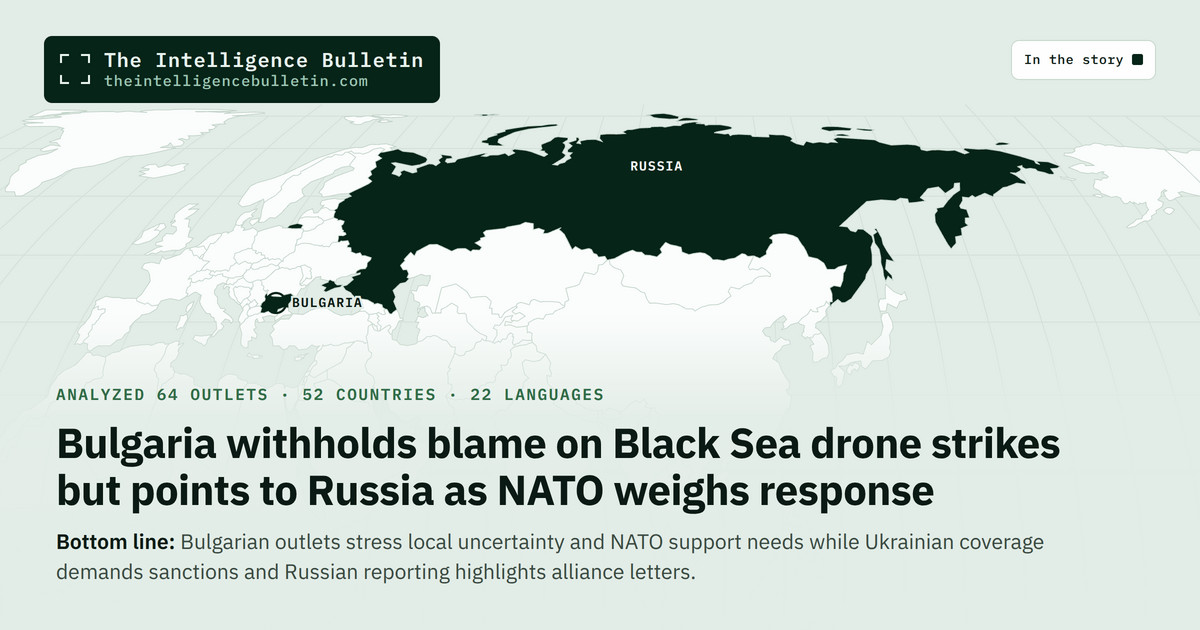
Bulgarian outlets stress local uncertainty and NATO support needs while Ukrainian coverage demands sanctions and Russian reporting highlights alliance letters.
- Single sourceBulgaria and Romania are preparing a joint letter to NATO for enhanced surveillance and intel sharing.Source: RIA Novosti citing Rapporteur
- Independently reportedDrones struck Chelsea 3 and Azov Concorde in Bulgaria’s Black Sea EEZ on October 13, sinking one and damaging the other.Source: The Sofia Globe, Al Jazeera, Hürriyet Daily News, Interfax-Ukraine citing Radev
- Independently reportedBulgarian PM Radev lacks clear evidence on drone origins but states logic indicates the outcome benefits Russia and will summon the Russian ambassador.Source: The Sofia Globe, Al Jazeera, Hürriyet Daily News, Interfax-Ukraine citing Radev
- Independently reportedUkrainian FM Sybiha blames Russia and calls for tougher sanctions.Source: Interfax-Ukraine, Hürriyet Daily News citing Sybiha
- What is the origin of the drones that struck the ships?
- Were the attacks carried out by Russian or Ukrainian forces?
- Will NATO or the EU provide the requested surveillance and investigative support?
Press quoted
Full analysis
Two merchant ships came under drone attack in Bulgaria’s Black Sea exclusive economic zone early on October 13, 2026. The Ukrainian-owned Chelsea 3, sailing under a Maltese flag and registered in Odesa, was struck by three aerial drones roughly 18 nautical miles east of Byala. Its 15 crew members—seven Ukrainians and eight Azerbaijanis—were rescued by Bulgarian border police and taken to the port of Varna, where five received treatment for minor injuries. A second vessel, the Turkish-owned Azov Concorde flagged in St Vincent and the Grenadines, was hit about 17 nautical miles from Krapets and sank, with one crew member rescued.
Bulgarian Prime Minister Rumen Radev described the strikes as unacceptable and placed them in the immediate vicinity of Bulgarian territorial waters. He convened an emergency security council meeting and announced plans to summon Russian ambassador Eleonora Mitrofanova for talks while also speaking with NATO Secretary General Mark Rutte. Radev stated that Bulgaria lacked clear evidence to attribute responsibility to either side yet noted that logic indicated the outcome benefited the Russian Federation. The country requested assistance from NATO and the European Union to investigate the origin of the drones and to strengthen air and maritime surveillance and response capabilities. Radev also referenced a similar set of drone attacks on October 6 that sank the cargo vessel Alfa Watan with the apparent loss of all hands and damaged the Able, whose crew was rescued.
Ukrainian Foreign Minister Andrii Sybiha attributed the strikes directly to Russia. He called on international partners to increase sanctions pressure, expand measures against Moscow, and take decisive steps to protect freedom of navigation. Sybiha described the Black Sea as a lifeline for global food security and accused Russia of weaponizing hunger.
European Commission President Ursula von der Leyen condemned the attacks as another front of escalation in the Russian war in Ukraine. She expressed solidarity with Bulgaria and thanked rescuers while stating that those responsible should be held accountable. NATO chief Mark Rutte said the alliance would continue working with Black Sea allies, monitor the security environment, and adjust its deterrence and defense posture as needed.
Russian state media reported that Bulgaria and Romania were preparing a joint letter to NATO calling for intensified surveillance and intelligence sharing on the Black Sea. The account cited officials and noted that the two countries planned to raise the matter at the European Council summit on October 15 and 16. It framed the episode against a backdrop of increased attacks by Ukrainian forces on civilian shipping and infrastructure at sea.
The accounts converge on the basic sequence of events. Four outlets—the Sofia Globe, Al Jazeera, Hürriyet Daily News, and Interfax-Ukraine—all reported the same details of the two ships, their flags and ownership, the distances from the Bulgarian coast, the crew compositions, and the outcomes of the rescues. They also carried Radev’s statements on the absence of conclusive evidence and his plan to summon the Russian ambassador. Ukrainian and Turkish reporting added Sybiha’s response and von der Leyen’s condemnation without contradiction.
The accounts diverge on attribution and the appropriate next step. Bulgarian coverage centers the uncertainty Radev voiced and the practical requests for investigative and surveillance support. Ukrainian coverage moves immediately from the strikes to sanctions escalation against Russia. Russian coverage foregrounds the NATO letter from Bulgaria and Romania and places the incidents in a pattern of Ukrainian attacks on shipping. Turkish and international reporting situates the strikes within a broader pattern of Black Sea maritime risk that has affected dozens of vessels in the past year.
A reader who encountered only Ukrainian reporting would see a clear Russian strike requiring stronger sanctions. A reader who encountered only Russian reporting would see a defensive NATO response prompted by Ukrainian actions. Bulgarian reporting, by contrast, withholds firm attribution while documenting the local consequences and the requests for alliance assistance. The corroborated details on ship ownership, crew nationalities, distances, and Radev’s exact phrasing on evidence and logic provide the strongest warrant for treating the Bulgarian account as the most precise description of what is known on the record. The single-source claim of a pending NATO letter from Bulgaria and Romania, carried only through Russian media citing Rapporteur, remains unconfirmed in the other outlets and therefore functions as one perspective rather than a settled development.
What to Watch
The episode shows how proximity to the affected waters shapes emphasis. Bulgaria, as the coastal state whose exclusive economic zone was struck, focuses on evidence thresholds and capacity needs. Ukraine, as the owner of one vessel and a direct party to the wider conflict, uses the incident to press for sanctions. Russia uses it to highlight alliance activity by neighbors. The shared facts of the strikes and rescues establish a baseline that all reporting accepts, yet the differing prescriptions for response reveal the distinct interests each capital brings to the same stretch of water.
That’s how the world told the story.
Get our daily open-source intelligence on world events in your inbox — one email a day, up to six stories.
Subscribe freeNo spam. One-click unsubscribe. See the latest email →