 AI-generated analysis published under the editorial responsibility of Rohit Sinnas. How it works →
| Press analyzed | 64 outlets · 55 countries · 18 languages |
| Press quoted | 3 sources, each independently reported |
See the 55 countries
Algeria, Argentina, Armenia, Austria, Azerbaijan, Bangladesh, Brazil, Canada, China, Cuba, Cyprus, Czech Republic, Dominican Republic, Ecuador, Egypt, Finland, France, Germany, Greece, India, Indonesia, Iraq, Ireland, Israel, Italy, Jordan, Kuwait, Luxembourg, Malaysia, Mauritania, Mexico, Morocco, Nepal, Netherlands, New Zealand, Nigeria, Oman, Pakistan, Paraguay, Qatar, Romania, Saudi Arabia, South Korea, Spain, Sri Lanka, Sweden, Switzerland, Syria, Turkey, United Arab Emirates, United Kingdom, United States, Venezuela, Vietnam, Yemen
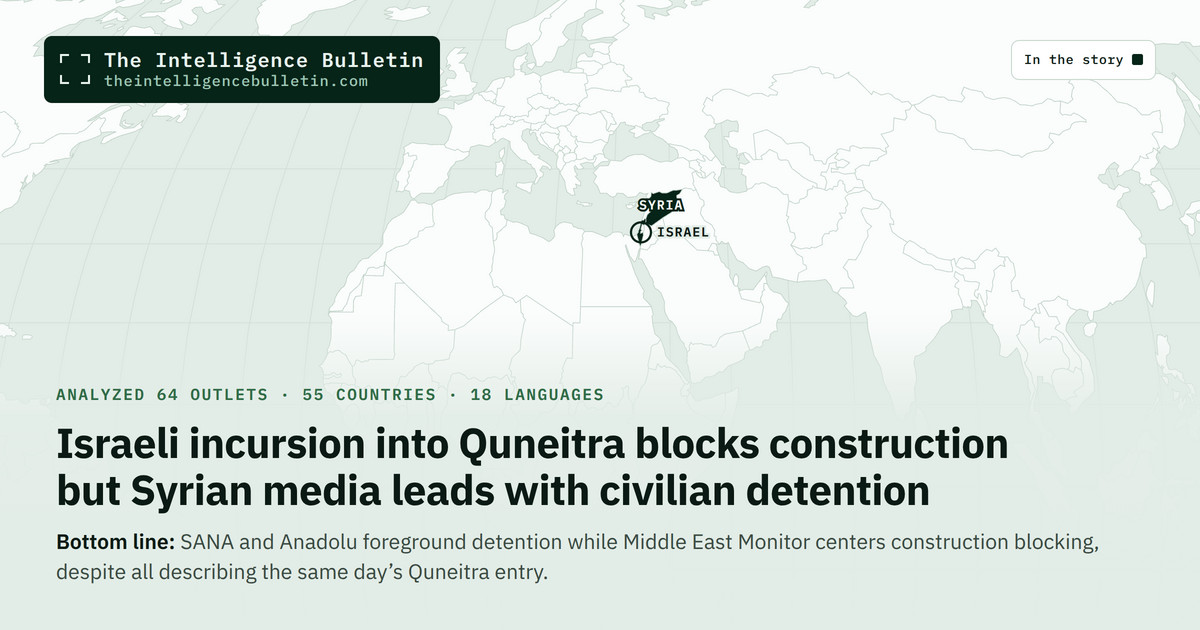
SANA and Anadolu foreground detention while Middle East Monitor centers construction blocking, despite all describing the same day’s Quneitra entry.
- Single sourceIsraeli forces with six military vehicles entered south of Al-Rafid in Quneitra and prevented residents from digging construction foundations.Source: Middle East Monitor citing Alikhbariah TV
- Single sourceIsraeli occupation forces detained a young man during an incursion into Bariqa village in southern Quneitra countryside, taking him toward the occupied Golan.Source: SANA correspondent
- Single sourceIsraeli forces abducted a man in southern Syria amid fresh incursions.Source: Anadolu Agency
- Single sourceIsrael has expanded operations in Syria since the fall of Bashar al-Assad’s regime, advancing into the demilitarized buffer zone.Source: Middle East Monitor
- Were the reported detention in Bariqa and construction blocking south of Al-Rafid the same incident or separate actions on the same day?
- What specific security or other rationale did Israeli officials provide for the incursion, if any?
Press quoted
Full analysis
On October 12, 2026, Israeli military vehicles entered Syria’s southern Quneitra countryside. One account described six vehicles advancing south of the town of Al-Rafid, where forces prevented local residents from digging foundations for new construction. A separate report placed four vehicles inside the old village of Bariqa, where troops searched several civilian homes before detaining a young man and transporting him toward the occupied Syrian Golan Heights. Drones flew overhead during the Bariqa operation. The same day, forces were also reported to have blown up an abandoned military barracks at Tal Harboun near the town of Beit Jinn in the western Damascus countryside.
These actions occurred against the backdrop of repeated Israeli crossings into the area. On the previous day, October 11, Israeli forces had detained three young men west of the village of Saida al-Jolan while they were herding sheep and prevented farmers in Wadi Abidin in the Yarmouk Basin area of western Daraa countryside from carrying out their work. Syrian state reporting tied the pattern to violations of the 1974 Disengagement Agreement, which established a buffer zone after the 1973 war. Damascus has long demanded full Israeli withdrawal from territory it considers occupied and has declared all Israeli measures there null and void under international law.
The October 12 incursion fits a larger expansion of Israeli operations inside Syria that began after the fall of Bashar al-Assad’s government on December 8, 2024. Israeli forces have since moved into the demilitarized buffer zone in the occupied Golan Heights and positions nearby. Syrian officials continue to insist on a return to the 1974 lines, while Israeli statements in the coverage frame the moves as driven by security considerations.
The three outlets that covered the day’s events placed sharply different weight on what the crossing actually accomplished. Syrian state media led with the detention of the young man in Bariqa and described the operation as an occupation incursion involving home searches and removal of civilians. It placed the event inside a running series of raids, detentions, land bulldozing, and shelling attacks that breach the disengagement line. Turkish state agency coverage centered the abduction of a man amid fresh incursions, using language that highlighted the removal of an individual rather than any engineering activity. The United Kingdom outlet that relayed Syrian television and carried Anadolu Agency imagery led instead with the prevention of foundation digging near Al-Rafid and treated the barracks explosion at Tal Harboun as a distinct but related action on the same day.
No account in the set included an on-record Israeli explanation of the specific purpose of the vehicles or the detention. The absence leaves the security rationale mentioned in one report without detail or rebuttal. Readers therefore encounter the same locations and vehicle movements through lenses that either stress civilian impact and legal violation or present the stoppage of construction work and a barracks demolition as the primary facts.
The divergence is not merely stylistic. Syrian state reporting consistently returns to the 1974 agreement and the demand for withdrawal, treating each crossing as confirmation that Israeli measures lack legal standing. The Turkish agency headline and the relayed Syrian television account both foreground the human element of removal from the area, while the construction-blocking detail appears only in the account that cites Alikhbariah TV. The post-Assad expansion of Israeli positions into the buffer zone receives mention only in the United Kingdom piece, supplying context that the Syrian state report omits. Because each outlet draws from its own correspondent or from a single Syrian broadcaster, the differences reflect distinct editorial choices about which element of the incursion merits the lead.
The reporting therefore supplies consistent geography and timing but leaves the central purpose of the incursion open to interpretation according to which outlet a reader follows. A reader limited to Syrian state media would see a pattern of occupation and civilian interference stretching back at least to the previous day’s detentions. A reader limited to the relayed account would see targeted stops on construction and the destruction of an abandoned structure. The Turkish agency account would emphasize the removal of an individual amid ongoing border pressure. None of the three supplies the Israeli government’s contemporaneous account of its own actions, so the event reaches audiences already filtered through Syrian or Turkish institutional priorities.
What to Watch
What follows from this limited sourcing is that the territorial intervention remains visible only through the eyes of parties directly affected or aligned with one side of the disengagement line. The 1974 agreement itself receives explicit citation only in the Syrian state account, while the post-Assad security rationale appears only in the United Kingdom relay. Without an independent Israeli statement or third-party observation in the set, the reader cannot weigh one framing against another on the basis of contemporaneous evidence from the actor that carried out the crossing. The next developments that matter are therefore whether additional reporting surfaces an Israeli explanation for the specific sites chosen on October 12 or whether further crossings produce comparable divergence in emphasis between detention and engineering activity.
That’s how the world told the story.
Get our daily open-source intelligence on world events in your inbox — one email a day, up to six stories.
Subscribe freeNo spam. One-click unsubscribe. See the latest email →