 AI-generated analysis published under the editorial responsibility of Rohit Sinnas. How it works →
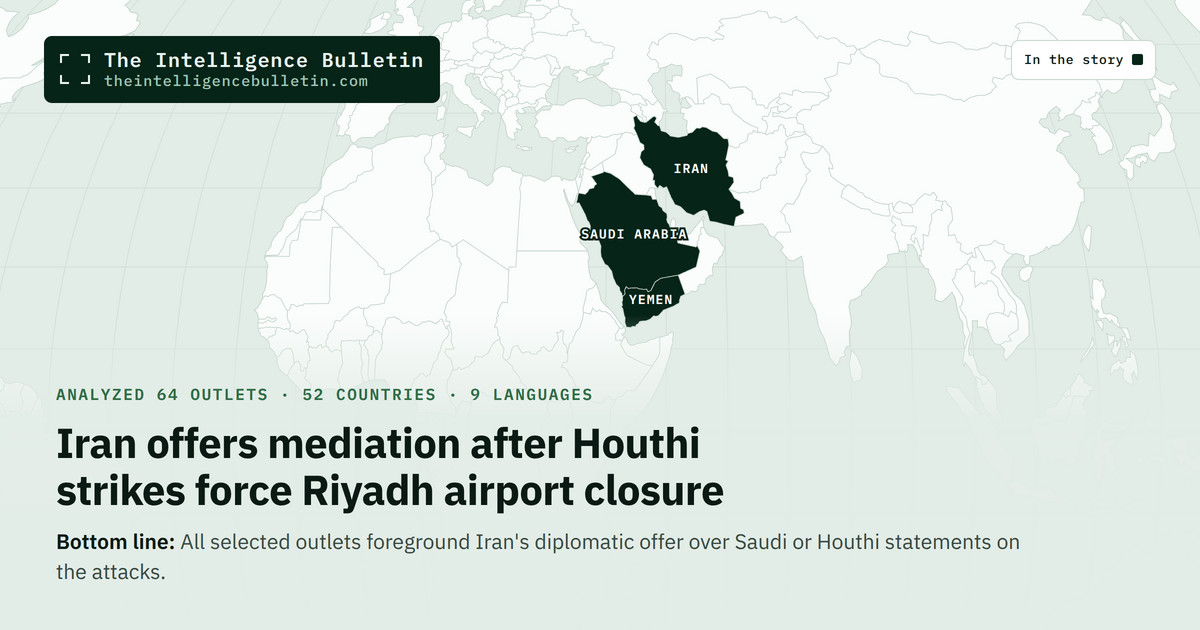
| Press analyzed | 64 outlets · 52 countries · 9 languages |
| Press quoted | 5 sources, each independently reported |
See the 52 countries
Afghanistan, Armenia, Australia, Austria, Azerbaijan, Barbados, Brazil, Canada, China, Cyprus, Egypt, France, Gambia, Germany, Ghana, Greece, Indonesia, Iran, Iraq, Ireland, Israel, Italy, Jamaica, Japan, Kenya, Kuwait, Kyrgyzstan, Lebanon, Malaysia, Mexico, New Zealand, Nigeria, Oman, Pakistan, Qatar, Romania, Saudi Arabia, Singapore, South Africa, South Korea, Spain, Sri Lanka, Switzerland, Syria, Turkey, Uganda, United Arab Emirates, United Kingdom, United States, Uzbekistan, Vietnam, Yemen
All selected outlets foreground Iran’s diplomatic offer over Saudi or Houthi statements on the attacks.
- Independently reportedIranian FM Araghchi offered assistance to initiate Saudi-Yemen dialogue during the phone call.Source: Iranian Foreign Ministry via Al-Monitor, JPost, Al Jazeera, The Nation
- Independently reportedHouthi attacks on Riyadh’s King Khalid International Airport killed at least 14 people and led to extended closure.Source: Saudi authorities and reports across Al-Monitor, JPost, The Nation
- Independently reportedAraghchi warned that military approaches would further complicate the situation.Source: Iranian statements via multiple outlets including Al Jazeera and The Nation
- Independently reportedThe call addressed regional escalation and de-escalation efforts.Source: Saudi and Iranian accounts via Anadolu, Al-Monitor, JPost
- What specific outcomes or follow-up steps, if any, were agreed during the ministers’ call?
- How will the Saudi-backed Yemeni government’s terror designation law affect potential talks?
Press quoted
Full analysis
Iranian Foreign Minister Abbas Araghchi spoke by telephone with his Saudi counterpart, Prince Faisal bin Farhan, on October 12 about the recent escalation in the region and efforts to reduce tensions. According to accounts from both sides, Araghchi offered Iran’s assistance in starting dialogue between Saudi Arabia and Yemen to reach a political solution. He stated that insistence on a military approach while disregarding diplomatic options would only further complicate the situation, and he stressed that the region’s crises could not be resolved by military means.
The call followed a weekend of Houthi missile and drone strikes on Saudi targets, most notably Riyadh’s King Khalid International Airport. Saudi authorities reported that one attack killed 13 people and wounded more than 300, while a follow-up strike killed one additional person and injured nearly a dozen. The airport remained closed through at least October 17 to complete safety checks, and multiple international airlines suspended flights, with some extending cancellations into 2027. The Houthis claimed responsibility and described Saudi airports and airspace as legitimate targets, while also alleging that Saudi-led forces had carried out more than 120 airstrikes on Sanaa and other Yemeni provinces in the preceding 24 hours. Those claims could not be independently verified in the reporting.
Saudi accounts of the ministers’ conversation confirmed the discussion of regional escalation and de-escalation efforts. Iranian statements added the specific offer of facilitation and the warning against military reliance. The Saudi-backed Yemeni government, for its part, advanced draft legislation designating the Houthis as a terrorist organization and targeting their financing, a step taken amid ongoing fighting along Yemen’s Red Sea coast.
Reporting from Al-Monitor placed the Iranian offer of dialogue at the center of the story and noted the parallel Yemeni legislative move against the Houthis. The Jerusalem Post carried Reuters material that detailed the airport closures, airline disruptions, and expert assessments of the unprecedented sustained attacks on civil aviation infrastructure. Al Jazeera reported both the Iranian and Saudi descriptions of the call and added that bin Farhan had also received calls from the British and Syrian foreign ministers, who condemned the Houthi strikes and expressed solidarity with Saudi Arabia. The Nation summarized the Iranian warning and the attack casualties in wire-service language. Anadolu Agency published the briefest account, limited to the fact that the two ministers had discussed regional escalation.
The accounts converge on the occurrence of the call itself and on Iran’s stated offer to help initiate talks. Four of the five outlets carried the Iranian Foreign Ministry’s description of Araghchi offering assistance and cautioning against military solutions. The casualty and closure figures for the airport attacks appear consistently in the pieces that address the strikes directly. No reporting in the set presented a detailed Saudi rebuttal or alternative framing of the conversation beyond the basic confirmation that escalation and de-escalation were discussed.
The Jerusalem Post piece stands apart by supplying operational detail on flight cancellations reaching 46 percent across Saudi airports and by quoting aviation analysts on the risks to civil aviation. Al Jazeera alone included the additional diplomatic contacts from Britain and Syria and the resulting travel advisories issued by several Western embassies. Al-Monitor alone linked the call to the Saudi-backed Yemeni government’s draft terror designation law. The remaining two outlets stayed within the shared statements without adding independent context.
The dominant thread across the coverage is therefore the Iranian diplomatic initiative rather than the attacks or any Saudi counter-position. Readers relying on any single outlet would encounter the same core sequence of statements but would miss the aviation disruption specifics carried by the Jerusalem Post, the additional diplomatic reactions noted by Al Jazeera, or the Yemeni legislative development highlighted by Al-Monitor. The absence of independent sourcing on the substance of the call itself means the record rests on the two foreign ministries’ accounts alone.
That convergence on Iran’s framing carries a clear implication. The reporting chains trace back to the same Iranian statements and the Saudi confirmation of the call, with limited additional color from Reuters material on the attacks. Saudi Arabia has an evident interest in emphasizing the damage and casualties from the strikes to maintain pressure on the Houthis and their Iranian backers. Iran has an interest in positioning the conversation as a constructive diplomatic opening that could draw Saudi Arabia away from military options. The fact that the Iranian account traveled more widely in this set of coverage suggests the offer of mediation aligned with the immediate news cycle more readily than the operational details of the airport attacks.
What to Watch
The next development to watch is whether the offer produces any concrete follow-up mechanism or whether the fighting along the Red Sea coast and the Yemeni government’s legislative push continue without interruption. The ministers’ conversation establishes a channel, but the reporting supplies no evidence of agreed next steps or of any shift in the underlying military dynamics.
That’s how the world told the story.
Get our daily open-source intelligence on world events in your inbox — one email a day, up to six stories.
Subscribe freeNo spam. One-click unsubscribe. See the latest email →